
Getting around Lisbon: metro, trams and walking requires a clear understanding of the city's vertical topography and transit ticketing. Lisbon spreads across steep limestone hills flanking the Tagus River, meaning a short horizontal distance on a digital map often translates into a grueling vertical climb. During my seven years living here, I have seen thousands of visitors waste hours waiting in unnecessary lines or pay double the standard fare simply because they did not understand how the local network connects.
The public transport system combines underground metro lines, modern buses, heritage streetcars, hillside funiculars, and suburban commuter rail. Each mode serves a distinct geographical purpose. When you pair smart card ticketing with strategic walking paths and public elevators, moving through Lisbon becomes fast, affordable, and remarkably scenic.
Getting Around Lisbon: The Fare System, Navegante Cards, and Contactless Rules
Physical Smart Cards vs Direct Contactless: Card Setup, Costs, and App Top-Ups
Every traveler using public transport in Lisbon needs a green, paper-based Navegante occasional card, which costs €0.50 (~$0.55 USD) to purchase at any station ticket vending machine. You might still see the name Viva Viagem on machine interfaces or older signage; Navegante occasional is simply the current branding of that identical reloadable system. This physical card is reusable for one year and stores either single journey tickets, 24-hour daily passes, or pay-as-you-go credit known as Zapping.
Metropolitano de Lisboa also offers contactless fare gate payment. You can tap a physical debit or credit card, or a mobile wallet on your smartphone, directly against the optical reader at any metro turnstile. A single journey tapped this way costs €1.92 (~$2.10 USD). While convenient if you arrive late without cash, direct bank card tapping has a major operational limitation: it only validates a single subway ride. It does not grant the free 60-minute transfer to buses and trams included with standard tickets, and it cannot be used on Carris surface transit vehicles.
To bypass lines at ticket vending machines inside major transport hubs, I use the official CARRISway mobile app on my smartphone. The app uses near-field communication (NFC) to read the physical Navegante card through the back of your phone and load single tickets or Zapping credit using a bank card. The official Navegante app offers similar top-up functionality. Note the golden rule of Lisbon transit: every traveler must carry their own separate Navegante occasional card. The ticketing gates reject consecutive card taps for a second passenger.
Ticket Options Compared: Single Fares, Zapping Credit, and 24-Hour Passes
Selecting the right fare category depends entirely on your daily itinerary. In 2026, a standard single Carris/Metro ticket costs €1.90 (~$2.08 USD). This ticket allows unlimited transfers between the underground metro and the surface Carris network of buses, funiculars, and trams for 60 minutes following your first tap, though it excludes two consecutive entries into the metro network.
If you take fewer than four journeys a day, loading Zapping credit onto your Navegante card is the most economical approach. In 2026, a Zapping ride costs €1.72 (~$1.88 USD) across the subway, Carris buses, historic trams, and funiculars. Zapping balances must be loaded in fixed increments: €3, €5, €10, €15, and then steps of €5 up to a maximum of €40. Keep in mind that unused Zapping credit on a temporary Navegante occasional card is non-refundable. Calculate your anticipated trips carefully before loading large sums.
| Ticket Type | 2026 Fare | Network Coverage | Best For |
|---|---|---|---|
| Single Carris/Metro | €1.90 | Metro, Carris buses, trams (60-min window) | Spontaneous single rides without preloaded funds |
| Zapping (Pay-as-you-go) | €1.72 | Metro, Carris buses, trams, funiculars, CP trains, ferries | Flexible, low-frequency transit days (1–3 trips) |
| Direct Contactless Metro | €1.92 | Lisbon Metro lines only (no surface transfer) | Arriving passengers without a Navegante card |
| 24-Hour Carris/Metro | €7.25 | All Metro lines, Carris buses, historic trams, Santa Justa Lift | Intensive urban sightseeing (5+ rides or funicular rides) |
| 24-Hour Carris/Metro/Transtejo | €10.35 | Urban network plus Transtejo ferry to Cacilhas | City sightseeing combined with south bank river crossing |
| 24-Hour Carris/Metro/CP | €11.40 | Urban network plus CP commuter rail to Sintra & Cascais | Full-day excursions to Sintra or Cascais |
A 24-hour unlimited Carris/Metro pass costs €7.25 (~$7.90 USD). The mathematical breakeven point for this pass occurs on your fifth ride if paying with Zapping (5 × €1.72 = €8.60), or on your fourth ride using single €1.90 tickets. However, if your day includes riding the Elevador de Santa Justa or historic funiculars, the €7.25 pass pays for itself on the first or second trip because onboard fares for those specialty lines are substantially higher.
Validation Protocols, Turnstile Etiquette, and Transit Penalty Fines
Lisbon enforces strict validation rules across its entire public network. On the Metropolitano de Lisboa, you must scan your card against the reader at the entry turnstile until the green light illuminates, and you must validate your card again at the exit turnstiles to leave the station. Never discard or misplace your card while underground; without an exit tap, the gate will not open, and station staff cannot verify your journey.
When boarding Carris buses and streetcars, passengers must board exclusively through the front door and tap their smart card against the yellow electronic reader behind the driver's cabin. Exiting occurs strictly through the middle and rear doors. To prevent read errors, hold your single Navegante card flat against the sensor. If you tap an entire wallet containing multiple contactless payment cards, the validator will register a card clash error and flash red.
Portuguese transit inspectors operate across all lines in uniform and plain clothes. Under Law no. 28/2006 (republished by Decree-Law no. 117/2017), traveling without a valid ticket constitutes a serious infraction carrying a fine of €120 to €350. Failing to validate an otherwise active pass constitutes a simple infraction with fines from €30 to €87.50.
Metropolitano de Lisboa: Navigating Subway Lines, Airport Connections, and Works
Airport Access via the Linha Vermelha and Key City Interchanges
Arriving travelers can access the city center via the subway directly inside Humberto Delgado Airport (LIS). The Aeroporto station sits outside the Terminal 1 arrivals hall and marks the northeastern terminus of the Linha Vermelha airport metro. Standard fares apply: a €1.90 single ticket or €1.72 with Zapping, with no airport surcharge added to your journey. You can read my complete breakdown of airport ground routes in this Lisbon airport transport comparison.
The Linha Vermelha cuts west across northern Lisbon, connecting to the other three subway lines through three major transfer stations. You interchange at Alameda for the Linha Verde (Green Line) heading south toward historic Baixa, Rossio, and Cais do Sodré. Transferring at Saldanha connects you to the Linha Amarela (Yellow Line) serving the financial district, while São Sebastião connects to the Linha Azul (Blue Line) for Avenida da Liberdade, Praça do Comércio, and Santa Apolónia rail station.
During morning peak hours (08:00 to 09:30) and evening commutes (17:30 to 19:00), trains run every 5 to 7 minutes, though late-night intervals stretch to 10 to 12 minutes. The Aeroporto station features elevators and wide fare gates suited for oversized luggage. In contrast, taking a ride-hailing vehicle (Uber or Bolt) from the airport terminal to central Baixa or Chiado typically costs €9 to €16 depending on dynamic surge pricing, while an official city taxi at the rank charges €15 to €22, including the mandatory €1.60 luggage surcharge.
Operating Schedule, Station Facilities, and Circular Line Detours
The Lisbon subway operates every day of the year from 06:30 to 01:00. This closing hour means that the final trains depart from their respective terminal stations at precisely 01:00; station entrances begin locking their street-level gates shortly after the last train clears the platforms. If you plan a night out, track your return route so you are not stranded outside closed gate grates after 01:00.
Network navigation requires attention to active infrastructure developments. The Lisbon Metro is completing the Linha Circular (Circular Line) project, connecting Rato on the Yellow Line to the riverside Cais do Sodré transport hub on the Green Line. This work introduces two brand-new underground stations: Estrela, situated near the Basilica, and Santos, located near the design district by the river. You can monitor system updates on the official Metropolitano de Lisboa projects portal.
Because tunneling and surface reconstruction are underway in these quarters, travelers will encounter construction hoardings and bus reroutings around Largo da Estrela and Avenida 24 de Julho near Santos. When walking between Rato and the riverfront, expect sidewalk diversions and temporary pedestrian walkways. If navigating these construction zones on foot with bags feels challenging, board local Carris bus routes rather than walking down the narrow detours.
Lisbon Tram Network: Historic Remodelados, Modern Low-Floors, and Realities
Riding the Historic Eléctrico 28E: Routes, Queue Tactics, and Transit Delays
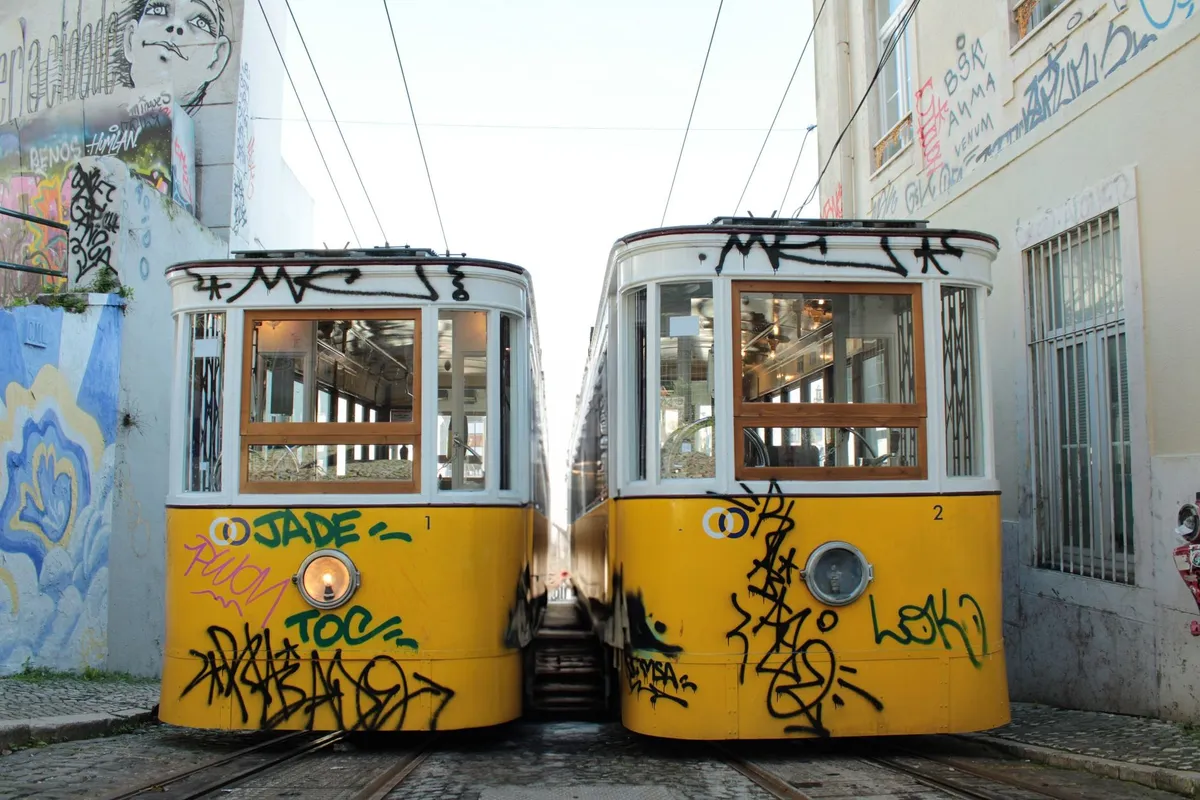
The yellow Remodelado tram of line 28E is one of Lisbon's most recognizable transit icons. Built in the 1930s and refurbished mechanically in the 1990s, these compact two-axle heritage vehicles operate on a specialized narrow-gauge track designed to handle 14% track gradients and corners as tight as an 18-meter radius. Line 28E connects Martim Moniz terminal to Campo de Ourique (Prazeres), winding through Graça, Alfama, Baixa, Chiado, and Estrela.
Riding line 28E as a scenic sightseeing vehicle during midday hours is often exhausting. Between 10:00 and 18:00, queues at the Martim Moniz starting terminal routinely stretch to 60 or 90 minutes under direct sun. Along the route, delivery vans and double-parked passenger cars on the narrow roads of Alfama and Calçada de São Francisco cause unexpected 30- to 50-minute route stoppages. Interior cabins are rarely air-conditioned and remain densely packed during peak daylight hours.
If you want to ride the 28E comfortably, arrive at Martim Moniz before 08:30 or after 20:00, when passenger queues vanish. Alternatively, catch the tram at its quiet western terminus in Campo de Ourique (Prazeres). To see Alfama's core without long lines, board the circular tram 12E at Praça da Figueira; it runs through the same historic turns near Miradouro de Santa Luzia with far fewer passengers.
Traveling to Belém on Tram 15E: Fleet Types, Accessibility, and Alternatives
Tram 15E runs along the riverfront from Praça da Figueira through Cais do Sodré to Algés (Jardim), serving as a direct transit link to the historic monuments in Belém. Unlike the vintage cars used in the hills, line 15E uses modern articulated, low-floor trams alongside classic Remodelado vehicles. The modern articulated cars make line 15E the only tram route in Lisbon accessible for manual wheelchairs and full-sized baby strollers.
Because line 15E is the default transit choice listed in many travel guides, boarding platforms at Praça da Figueira and Cais do Sodré suffer from heavy passenger crowding throughout the morning. If the line 15E queue is backed up, you have several faster alternatives to reach Belém without waiting. You can read detailed transit connections in my dedicated Belém neighborhood planning guide.
Carris express bus 728 departs Praça do Comércio and Cais do Sodré every 10 to 15 minutes, stopping directly at Mosteiro dos Jerónimos in approximately 15 minutes using the riverside bus lane. Carris bus 714 also runs from Cais do Sodré through central Belém. Even faster is the CP suburban commuter rail on the Cascais line: boarding an urban train at Cais do Sodré rail station brings you to Belém station in precisely 7 minutes for €1.45 (or €2.00 using Zapping credit).
Boarding Protocol, Onboard Driver Surcharges, and Pickpocket Precautions
Boarding discipline on Carris surface lines protects both your safety and your travel budget. Whenever you enter a standard bus or historic streetcar, step through the forward door, tap your Navegante card against the yellow reader beside the driver, and step toward the center aisle. Entering through the middle or rear exit doors is illegal and attracts penalty checks from roving inspectors.
Purchasing paper tickets directly from the vehicle operator on board incurs a steep financial penalty designed to discourage onboard cash transactions. In 2026, an onboard single tram ticket costs €3.30 (~$3.60 USD), compared to €1.72 when validating with Zapping credit—a 92% surcharge. An onboard bus ticket bought from the driver costs €2.30, compared to the €1.72 smart card rate. Always preload your Navegante card before walking to the stop.
Professional pickpocket syndicates operate systematically along lines 28E and 15E, focusing on Martim Moniz, Praça da Figueira, and Belém-Jerónimos. Thieves create artificial bottlenecks during front-door boarding to distract passengers while accomplices unzip bags. Wear backpacks across your chest before entering the queue, keep phones inside zipped front pockets, and avoid handling cash while boarding.
Historic Vertical Funiculars and the Elevador de Santa Justa
Elevador de Santa Justa: Cabin Rides, Miradouro Pricing, and Free Walk-Up Access
Designed by Raoul Mesnier du Ponsard and opened in 1902, the Elevador de Santa Justa is a neo-Gothic iron vertical lift linking the lower streets of Baixa (Rua de Santa Justa) with the elevated Largo do Carmo. The elevator contains two polished wood-and-brass cabins that carry passengers up 45 meters in roughly 45 seconds. An onboard ticket purchased at the ground-level ticket counter costs €6.20 (~$6.75 USD) for up to two trips.
Riding inside the elevator cabin is covered at no extra charge if you hold an active €7.25 24-hour Carris/Metro pass, or it costs €1.72 if you validate your card with Zapping credit. However, visitors frequently wait between 45 and 90 minutes in a stagnant street queue at Rua de Santa Justa just to experience this 45-second vertical ride. This wait is rarely worth the lost sightseeing time.
Accessing the upper observation platform (Miradouro do Elevador de Santa Justa) requires an entirely separate viewing terrace ticket costing €5.00 (~$5.45 USD), payable exclusively by physical or digital bank card. This terrace fee is not included in standard 24-hour passes, Zapping validations, or the Lisboa Card, as outlined in the official Santa Justa Miradouro service announcement.
You can bypass the ground queue entirely and enjoy the identical panoramic perspective without paying. Walk from Baixa up Rua Garrett, turn right up Calçada do Sacramento, and enter Largo do Carmo. Walk around the right flank of the Carmo Convent ruins along the pedestrian walkway. This takes you directly onto the open-air iron connecting bridge behind the elevator tower for free, offering views across the Baixa grid to the castle.
Ascensores da Bica, Glória, and do Lavra: Transit Fares and Hill Climbs
Lisbon maintains three heritage cable-driven funiculars operated by Carris, each designated as a National Monument. Buying a paper ticket from the conductor inside the car costs €4.30 (~$4.70 USD) for up to two trips. In contrast, tapping your preloaded Navegante card deducts the standard Zapping transit fare of €1.72, while the 24-hour Carris/Metro pass covers the ride entirely.
- Ascensor da Bica: Climbs the narrow corridor of Rua da Bica de Duarte Belo from Rua de São Paulo to Calhariz, connecting the riverfront with Bairro Alto. It is Lisbon's most scenic funicular track, framed by classic balconies and laundry lines.
- Ascensor da Glória: Connects Praça dos Restauradores directly to the Miradouro de São Pedro de Alcântara. During maintenance periods or operational pauses on the funicular, Carris runs bus replacement route 51E between Restauradores and Largo do Carmo.
- Ascensor do Lavra: Lisbon's oldest funicular, opened in 1884. It ascends from Largo da Anunciada to Rua Câmara Pestana near Jardim do Torel. It carries few tourists, making it an easy way to experience a historic funicular climb without lines.
Getting Around Lisbon on Foot: Cobblestones, Elevators, and Topography
Calçada Portuguesa Realities: Street Gradients, Footwear, and Wet Weather Hazards
Walking is the best way to uncover Lisbon's historic neighborhoods, but the local street paving demands preparation. The city's footpaths are constructed from traditional calçada portuguesa, a mosaic pavement composed of small, hand-cut cubes of white limestone (calcário) and dark basalt. Decades of pedestrian foot traffic polish the limestone surface until it becomes smooth as finished marble.
When morning Atlantic sea mist rolls across the river, or during the first minutes of rainfall, polished limestone slopes become slick. The steep descents through Alfama, Mouraria, and the alleys dropping from Bairro Alto into Bica present real slipping hazards. Walk with deliberate steps, stay off smooth stone transitions, and look ahead at sidewalk slopes.
Footwear choice is essential. Shoes with slick leather soles, high heels, and worn EVA foam running shoes lack the friction required for these stones. I walk these hills in rubber-soled footwear with deep tread patterns (such as Vibram or lugged running outsoles) that provide grip on damp stone. For tips on structuring walking routes across multiple days, consult my tested three-day Lisbon walking itinerary.
Public Lift Shortcuts: Using Metro Escalators and Urban Passages
Lisbon's public urban planners integrated several elevators and escalator corridors into the urban fabric to help residents move between upper and lower districts without tackling grueling stone stairs. These shortcuts save time and stamina across a day of walking.
- Baixa-Chiado Metro Station Escalators: Enter the station vestibule at the lower level on Rua do Crucifixo (or Rua da Vitória) and ride the continuous multi-tiered escalators straight up to the Largo do Chiado exit. This transit corridor bypasses the steep climb of Calçada do Sacramento for free without passing through ticket gates, though maintenance can occasionally take individual escalator sections out of service.
- Elevador do Castelo Corridor: Located inside an unassuming doorway at Rua dos Fanqueiros 176, this free municipal lift ascends straight to Rua da Madalena. Step across the street into the former Mercado do Chão do Loureiro (now an urban parking structure), where a second public elevator carries you directly onto Costa do Castelo, steps from the castle entrance. Plan your route using my detailed guide to visiting São Jorge Castle.
- Elevador da Sé: Located at Rua Afonso de Albuquerque 38 near the Campo das Cebolas river plaza, this public lift carries pedestrians up the hill to the street terrace behind the Sé de Lisboa Cathedral, eliminating the climb up the lower Alfama stone ramps.
- Armazéns do Chiado Department Store: Walk into the ground floor of this shopping center at the corner of Rua do Carmo and take the internal department store escalators or elevators up to the top floor exit, which opens onto Rua Garrett.
Multimodal Connections: Interchanging Metro, Suburban Trains, and Ferries
Navigating Transit Terminals: Cais do Sodré, Rossio, and Martim Moniz
Understanding Lisbon's transport hubs ensures smooth transfers between urban transit, suburban rail lines, and Tagus river ferries. Each hub serves specific corridors and uses separate turnstile lines.
Cais do Sodré is the city's largest multimodal interchange, structured across three levels. Below ground lies the southern terminus of the Green subway line. At street level sits the terminal for CP commuter trains on the Cascais line, alongside Carris tram stops (lines 15E and 18E). Facing the water is the Transtejo Soflusa passenger ferry terminal serving Cacilhas, Montijo, and Seixal. Keep your cards organized: you cannot scan a CP rail ticket at the subway gates or vice versa.
Rossio Station, featuring a Manueline horseshoe-arch facade in central Baixa, serves only CP commuter trains on the Sintra line. The rail platforms sit on the upper level, accessed via street escalators. Martim Moniz, located on the northern edge of the historic center, serves as the eastern terminus for historic trams 28E and 12E, while providing underground access to the Green subway line.
Integration with Suburban Lines to Sintra, Cascais, and Trans-Tagus Ferries
Commuter train lines and river ferries fall outside standard urban bus-and-subway tickets, requiring either an extended transit pass or Zapping balance. If you are taking a day trip, buy the extended 24-hour Carris/Metro/CP pass for €11.40 (~$12.45 USD). This pass covers all Lisbon urban transport plus unlimited round-trip commuter rail travel to Sintra (departing Rossio or Oriente) and Cascais (departing Cais do Sodré).
If you cross the Tagus River to visit the Cristo Rei monument or dine along the riverfront in Cacilhas, board the orange Transtejo passenger ferries at Cais do Sodré terminal. The ferry crossing to Cacilhas takes 10 minutes and offers views of the 25 de Abril suspension bridge. A single ferry ride costs €1.53 (~$1.67 USD) deducted through Zapping credit, or you can purchase the combined 24-hour Carris/Metro/Transtejo daily pass for €10.35 (~$11.30 USD).
The standard €7.25 24-hour Carris/Metro pass does not validate on CP commuter trains to Sintra or Cascais, nor does it work on Transtejo ferries. If you board a suburban train or ferry using an unextended urban pass, you risk being stopped at platform turnstiles or issued an infraction fine by CP rail inspectors.
The Transit Strategy Checklist: Selecting the Best Mobility Setup for Your Trip
Tailored Transport Scenarios: High-Paced Sightseers, Families, and Budget Walkers
Selecting the best transport setup depends on your travel pace, physical mobility, and accommodation location. When picking your base in the city, cross-reference transit links using my guide to Lisbon's best neighborhoods.
- The High-Paced Sightseer (4+ transit trips per day): Purchase a Navegante occasional card (€0.50) and load the 24-hour Carris/Metro pass for €7.25. This grants unlimited use of the subway, city buses, historic trams, funiculars, and the Santa Justa lift cabin without worrying about per-ride deductions.
- The Mixed Walker (1 to 3 transit trips per day): Buy a Navegante card and load €10 or €15 in Zapping credit. You pay a reduced rate of €1.72 per ride on the subway, buses, and trams, keeping your transport costs low without paying for unneeded unlimited access.
- Day Trippers to Sintra or Cascais: Load the multimodal 24-hour Carris/Metro/CP pass for €11.40 at any station machine. It covers your subway connection to the terminal, your round-trip CP suburban train, and evening buses back to your hotel.
- Families with Young Children and Mobility-Restricted Travelers: Avoid line 28E and the steep stone stairs of upper Alfama. Rely on the modern articulated low-floor cars of tram line 15E to visit Belém, use elevator-equipped metro stations, and hail Bolt or Uber rides (€4 to €8 across central districts) to reach higher viewpoints like Miradouro da Senhora do Monte.
The Five Most Expensive Transit Mistakes in Lisbon and How to Avoid Them
Navigating Lisbon's transit system without checking fares can lead to avoidable extra costs. Here are the five costliest financial mistakes visitors make:
- Paying cash to vehicle drivers: Buying single tickets on board costs €3.30 on trams and €2.30 on buses. Loading Zapping credit drops that same journey to €1.72, saving you up to 92% per ride.
- Buying onboard tickets for the Santa Justa Lift: Paying the €6.20 onboard lift fare is unnecessary when the €7.25 24-hour Carris/Metro pass covers the cabin ride completely, or when you can walk onto the bridge behind Carmo Convent for free.
- Waiting in line for the Santa Justa Miradouro: Queuing on the street without realizing the top viewing terrace costs an extra €5.00 (bank card only) and is not included in transit tickets or tourist passes.
- Tapping one Navegante card for two passengers: Transit turnstiles reject consecutive card taps. The second person will be blocked by the closing turnstile gates and risks a fine for boarding without validation.
- Boarding Carris surface transit through exit doors: Entering buses or trams through the rear doors without tapping the front validator risks an inspection fine between €120 and €350 under Portuguese Law no. 28/2006.