
Humberto Delgado Airport (LIS) sits merely seven kilometers north of the city center, but navigating Lisbon Airport to the city: choosing your transfer requires weighing steep terrain against heavy baggage. While the runway borders the urban grid, the medieval layout of Lisbon presents micro-logistical hurdles immediately upon arrival. Steep inclines, cracked limestone sidewalks, and distinct transit rules penalize poor planning.
My years of testing connections between Portela and the central bairros show that the quickest route depends directly on your destination's topography. Public transit routes feature strict baggage thresholds, and taxi queues fluctuate rapidly when multiple flights disembark simultaneously. Selecting your transfer requires matching your luggage size, arrival hour, and physical destination against the city's unique transport network.
Airport Layout and Arrival Orientation: Terminal 1, Terminal 2, and Navigating LIS
Navigating the Terminal 1 Arrivals Hall and Baggage Claim
Every commercial passenger flight landing at Humberto Delgado Airport processes through the Terminal 1 arrivals hall. After collecting your bags and clearing customs, you walk through the sliding frosted doors into a bustling public concourse. The concourse is structured along a single straight axis, but moving through the crowds with full-sized luggage carts can be cumbersome during peak afternoon arrival banks.
Transit options diverge clearly once you clear the customs threshold. The entrance to the underground metro station sits to your far right, down a set of escalators and adjacent elevators. If you step straight ahead through the glass main exit doors, you will encounter the curbside licensed taxi rank. Reaching the ride-hailing pickup area requires turning left past the Starbucks counter and following the overhead TVDE directional signs leading outside toward the parking structures.
If your schedule includes an early arrival before check-in or a long layover, automated left-luggage lockers operate landside. You can access these 234 self-service ANA storage lockers 24 hours a day outside on the Departures level, right near the Kiss & Fly drop-off zone. Lockers are tiered across four sizes: Small costs €3.60 for 3 hours up to €8.40 for 24 hours; Medium costs €6.00 for 3 hours up to €10.80 for 24 hours; Large runs €9.60 for 3 hours up to €16.80 for 24 hours; and Extra Large charges €14.40 for 3 hours up to €24.00 for 24 hours, according to the Lisbon Airport official passenger guidance.
If you have an awkward check-in gap, drop your heavy luggage at the Terminal 1 Departures lockers before descending into the metro. Carrying large bags through intermediate stations while sightseeing will exhaust you on Lisbon's escalators.
Connecting to Terminal 2 Low-Cost Departures via the Free Inter-Terminal Shuttle
Terminal 2 low-cost departures functions strictly as an outbound departure terminal for budget carriers, including Ryanair, Wizz Air, and EasyJet. There are no passenger arrivals at Terminal 2; incoming flights operated by these airlines disembark and send their passengers through baggage claim at Terminal 1. If your journey requires transferring to an outbound low-cost flight, you must transfer between the two buildings landside.
A complimentary free inter-terminal shuttle bus runs continuous circuits between Terminal 1 and Terminal 2. The shuttle departs from the curbside bus stop located right outside the Terminal 1 Departures floor, operating daily between 03:30 and 00:30 at 12-minute intervals. The transit run between the terminals takes approximately 3 minutes along the perimeter service road.
Budget your time carefully if you are connecting between flights across terminals. Terminal 2 features basic waiting facilities and high passenger volumes at security checkpoints during early morning departure waves. Because you must clear security again at Terminal 2, I suggest arriving at the Terminal 1 shuttle stop at least two and a half to three hours prior to your scheduled flight departure.
Double-check your departure terminal on your boarding pass before traveling to the airport. Public buses and the metro terminate exclusively at Terminal 1, meaning you must always factor in the 12-minute shuttle headway to reach Terminal 2.
The Lisbon Metro: Linha Vermelha Routes, Transfers, and Key Connections
Direct Boarding at Aeroporto Station and Major Metro Interchange Hubs
Aeroporto metro station connects directly to the Terminal 1 arrivals hall via escalators and lifts, making the Linha Vermelha (Red Line) the most direct transit link into the urban core. The line operates from 06:30 to 01:00 daily, running trains every six to nine minutes during standard operational hours. The station concourse is spacious and decorated with caricatures of prominent Portuguese cultural figures along the tiled walls.
The Red Line serves as an east-west transit arc that intersects the city's other three subway arteries. To reach the historic core, ride southwest to Alameda transfer station and connect to the Linha Verde (Green Line). Passengers heading toward the central business district and Campo Pequeno can change at the Saldanha Yellow Line connection. The Red Line terminates at the São Sebastião Blue Line interchange, which provides direct connections to Avenida da Liberdade, Praça dos Restauradores, and Santa Apolónia rail terminal.
Station accessibility varies significantly throughout this historic network. While newer Red Line stations feature working lifts, older transfer hubs like São Sebastião and Baixa-Chiado involve long pedestrian tunnels and steep underground escalators. If an escalator undergoes maintenance, carrying heavy luggage up three flights of concrete stairs becomes physically demanding. You can check daily operational statuses on the Metro Lisboa operational portal.
Check the live elevator monitor on the metro operator's portal before descending into the turnstiles if you travel with reduced mobility or multiple check-in suitcases.
Reaching Intercity Rail: Gare do Oriente Train Connections
If your Portuguese itinerary extends beyond the capital to Porto, Coimbra, Braga, or the Algarve, Gare do Oriente train connections provide your primary departure point. Located just three metro stops away from the airport on the Red Line, the journey underground from Aeroporto station to Oriente takes roughly six minutes. The train glides past Encarnação and Moscavide before arriving at the lower platform level of the transit terminal designed by Santiago Calatrava.
Gare do Oriente concentrates high-speed Alfa Pendular (AP) and Intercidades (IC) express trains run by state rail carrier Comboios de Portugal. Rather than catching a highway taxi through unpredictable traffic along Avenida de Berlim, taking the metro guarantees your arrival time for tight train departures. Road transit along this avenue frequently stalls for 15 to 25 minutes during weekday morning rush periods, whereas the metro runs on a fixed timetable.
Once you step off the subway train at Oriente, take the central escalators or elevators up to the main station mezzanine to reach the national rail ticket offices and overhead departures boards. Municipal metro tickets do not cover national rail services; you will need separate boarding passes for long-distance CP trains before taking the upper escalators to the elevated open-air railway platforms.
If connecting to an intercity train at Oriente, give yourself at least 20 minutes between stepping off the metro and train departure to navigate the vertical levels with your baggage.
Connecting to the Historic Center: Reaching Baixa-Chiado and Rossio
To reach downtown districts such as Baixa-Chiado and Rossio, board the Red Line at Aeroporto, travel nine stops to Alameda, and transfer to the Green Line heading south toward Cais do Sodré. The transfer requires walking down an illuminated underground corridor following green directional signs. From Alameda, the Green Line takes roughly eight minutes to reach Rossio and Baixa-Chiado, bringing total platform-to-platform travel time to 25–30 minutes.
Navigating the exit gates at Baixa-Chiado station requires careful attention to the street signs. The station sits deep beneath the hillside, featuring two distinct exit complexes. Choosing the Rua do Crucifixo exit brings you onto flat ground in the center of the grid-pattern Baixa district. Selecting the Largo do Chiado exit requires riding four long, steep escalators directly into the elevated Chiado shopping quarter.
Be mindful of personal belongings when changing trains at Alameda or arriving at tourist-dense stations such as Rossio and Baixa-Chiado. Crowded vestibules offer opportunities for pickpockets who target distracted tourists wrestling large bags onto train doors. Keep your wallet, passport, and phone inside zipped interior compartments rather than in exterior backpack sleeves.
Exiting Baixa-Chiado via the wrong portal will leave you stranded at the top or bottom of a massive hillside. Check your hotel address carefully: choose Rua do Crucifixo for Baixa, or Largo do Chiado for upper Chiado.
Fares and Ticketing: Contactless EMV, Navegante Cards, and Penalty Rules
Contactless EMV Tap-to-Pay vs. The Navegante Occasional Card
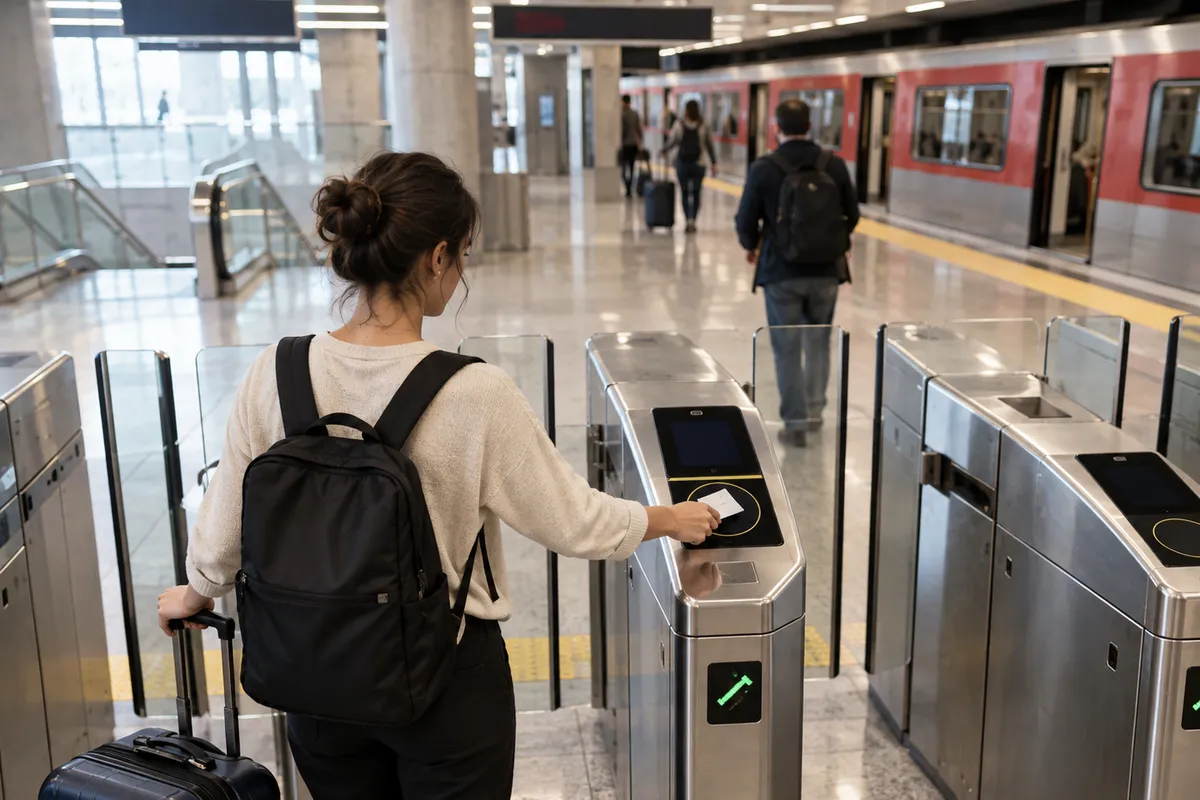
Navigating fare gates at Lisbon airport metro station has become significantly simpler thanks to contactless EMV tap-to-pay technology. In 2026, passengers can tap a contactless physical bank card, smartphone, or smartwatch directly against the turnstile reader. The gate registers an automated single fare of €1.92 per ride, deducting the amount directly from your account without the need to purchase a paper ticket or wait in kiosk queues.
Alternatively, passengers can purchase the rechargeable magnetic Navegante occasional card, which serves as the direct Viva Viagem replacement. The physical card incurs a one-time, non-refundable purchase fee of €0.50 at automated vending machines. A standard occasional single journey loaded onto the card costs €1.90 and remains valid for 60 minutes across both the Metro and the Carris urban bus network after its initial validation, allowing transfers between systems.
Strict individual validation rules apply across the entire network. Every traveler must tap their own card or smart device; multi-passenger validation on a single Navegante card or payment card is technically blocked. If you are traveling with companions or children, each individual must hold a separate payment card or physical Navegante card to pass through the electronic barriers.
| Payment Method | Single Fare (2026) | Initial Card Fee | Network Validity | Queue Requirement |
|---|---|---|---|---|
| Contactless EMV Tap | €1.92 | None | Metro only (single entry) | Zero (tap at barrier) |
| Navegante Occasional | €1.90 | €0.50 | 60-min Metro & Carris network | Vending kiosk purchase |
| Zapping Balance | €1.72 | €0.50 | Multi-modal (Metro, Bus, CP) | Initial kiosk top-up |
Zapping Pay-As-You-Go Balance and the 24-Hour Network Pass
For visitors intending to use public transit frequently over several days, loading Zapping pay-as-you-go balance onto a Navegante occasional card offers measurable cost savings. In 2026, a Zapping fare drops the cost of a single metro journey down to €1.72. The ticket kiosks at Aeroporto station provide fixed Zapping top-up increments of €3, €5, €10, €15, €20, €25, €30, €35, and €40, according to current Metro Lisboa fare tariffs.
If you plan an intensive sightseeing schedule on your arrival day, the Carris/Metro 24-hour network ticket costs €7.25 from the moment of first validation. This pass covers unlimited rides on the underground metro, standard Carris buses, historical funiculars (such as Bica and Glória), and the Santa Justa Lift. It also includes the popular vintage streetcar routes like Tram 28E, where a single onboard ticket purchased with cash from the driver costs €3.10.
The financial break-even calculation for the 24-hour network pass is straightforward. If you take the metro from the airport and subsequently ride three or four transit segments during your first afternoon, or take one metro trip and two vintage tram rides, the €7.25 ticket pays for itself. However, do not load excessive Zapping credit onto a card you plan to discard, as unused balances cannot be refunded at station windows.
If you plan to ride Tram 28E or the Santa Justa Lift during your first 24 hours, buy the €7.25 network pass at the airport metro kiosk rather than paying individual cash fares on board.
Gate Validation Procedures and Statutory Penalty Enforcement
Lisbon utilizes a closed turnstile transit network, meaning you must tap your card or device twice on every underground journey. You must tap at the entry gate to unlock the barrier, and you must tap your card again at the exit turnstiles to leave your destination station. Failure to retain your ticket throughout your journey will leave you unable to clear the exit barriers without staff assistance.
Under Portuguese Lei n.º 28/2006, traveling without a validated fare or failing to produce a ticket upon inspection constitutes an administrative offense. Statutory fines range from €120 to €350. Transit inspection officers, accompanied by security personnel, routinely verify passenger tickets inside train cars and directly behind the exit turnstiles at popular central stations.
If you tap into the network using a contactless credit card or smartphone, ensure the device maintains sufficient battery power for the duration of the trip. Transit controllers carry mobile verification terminals that scan your payment card or virtual token to confirm the entry timestamp. Statutory discounts of 40% to 75% apply if penalties are settled promptly on site, but validating your fare properly eliminates any risk.
Never throw away your paper ticket or let your smartphone battery die while riding the metro. You must tap out at the exit barrier, and controllers frequently inspect passengers right beside the exit gates.
Municipal Buses and Late-Night Transit: Carris Routes vs. The Discontinued Aerobus
Discontinuation of Aerobus and the Current Ground Transit Reality
Many printed guidebooks and outdated internet resources continue to recommend the Aerobus express shuttle for travel between Portela Airport and the city center. This dedicated airport shuttle bus, previously operated by Carristur with onboard luggage racks, has been permanently discontinued and removed from the airport's transit operations. The former curbside Aerobus ticketing kiosks in the arrivals area have been dismantled.
The removal of the Aerobus service leaves municipal Carris city buses and the underground metro as the only scheduled public transport links serving Humberto Delgado Airport. There are no specialized luggage shuttles operating scheduled express runs between Terminal 1 and downtown hotels. Travelers looking for dedicated luggage transport must choose between local city buses, taxis, or ride-hailing services.
Ignore any unverified third-party platforms attempting to sell advance vouchers for airport express bus connections to central Lisbon squares. Ground transit options are strictly divided between public municipal transport and private automotive transfers. Understanding this distinction prevents costly booking mistakes before your flight touches down.
Do not attempt to purchase "Aerobus" tickets online or follow signs from outdated guidebooks. The service is permanently defunct, and municipal Carris buses run on standard city transit regulations.
Carris Municipal Bus Routes and Passenger Luggage Size Limits
Several standard Carris municipal bus routes stop directly along the curbside roadway outside Terminal 1 Arrivals. Route 705 connects Gare do Oriente to Roma-Areeiro on weekdays only, with departures every 15 to 20 minutes. Route 722 links the airport with Praça de Londres every 20 to 30 minutes. Route 744 runs daily between Moscavide and Marquês de Pombal or Restauradores at intervals of 12 to 20 minutes, while Route 783 travels via Marquês de Pombal to Amoreiras every 15 to 30 minutes, according to the Carris official schedules.
Passenger luggage restrictions represent a significant limitation for these municipal services. According to Carris operational regulations, the maximum Carris luggage dimensions limit permitted inside passenger compartments is 55x40x20 cm, matching standard airline carry-on parameters, though Lisbon Airport advisories recommend keeping items within 50x40x20 cm. Because these buses are standard commuter vehicles without dedicated luggage storage racks, drivers have statutory authority to deny boarding to passengers carrying large check-in suitcases.
Ticketing on Carris buses reflects their municipal focus. You can board using a pre-validated Navegante card with a 60-minute single ticket (€1.90), a Zapping balance (€1.72), or a 24-hour pass (€7.25). If you choose to buy a single ticket onboard directly from the driver, the cash fare in 2026 is €2.30. This cash ticket is valid exclusively for that specific vehicle journey and does not permit free transfer into the metro network.
| Carris Bus Route | Key Destination Corridor | Operating Schedule | Typical Frequency |
|---|---|---|---|
| Route 705 | Oriente to Roma-Areeiro | Weekdays only | Every 15–20 minutes |
| Route 722 | Portela to Praça de Londres | Daily service | Every 20–30 minutes |
| Route 744 | Marquês de Pombal & Restauradores | Daily service | Every 12–20 minutes |
| Route 783 | Marquês de Pombal & Amoreiras | Daily service | Every 15–30 minutes |
Late-Night Transit After Metro Closure: Carris Night Bus 208
The Lisbon Metro closes its gates daily at 01:00 and does not resume service until 06:30. Travelers arriving on late-night European flights or delayed international arrivals after 01:00 face limited public transit options. During this early-morning transit window, the Carris overnight bus route 208 serves as the primary public transit lifeline between the airport and the downtown center.
Route 208 operates every night between approximately 23:30 and 05:35, running at reliable 30-minute headways. The route begins at Estação Oriente, stops at Terminal 1 Arrivals, passes through Alameda, and terminates at Cais do Sodré via Praça da Figueira in the historic center. The journey from the airport to downtown takes roughly 25 to 35 minutes depending on nighttime road conditions.
The boarding stop for Route 208 is situated directly outside the Terminal 1 arrivals exit on the outer bus lane. You can pay using an existing Zapping balance (€1.72), an active 24-hour pass, or by handing €2.30 cash to the driver. When paying the driver, carry coins or small banknotes, as drivers frequently cannot provide change for €20 or €50 notes during night shifts.
If your flight lands after 00:30, do not count on catching the final 01:00 metro train. Border control and baggage claim can take 40 minutes, making night bus 208 or a licensed taxi your only viable choices.
Private Road Transfers: Licensed Taxis vs. TVDE Ride-Hailing (Uber and Bolt)
Official Licensed Taxis: Taximeter Tariffs, Night Surcharges, and Boot Fees
Official licensed taxis wait in a continuous line at the designated taxi rank directly on the curbside pavement outside the Terminal 1 arrivals exit. Lisbon taxis are easily recognizable by their cream-colored body or classic black-and-green livery with illuminated roof signs. These vehicles operate under strict municipal regulations and utilize calibrated taximeters to calculate fares based on elapsed time and distance traveled.
Standard urban taxi trips adhere to two distinct regulated tariff tiers under the national taxi framework overseen by ANTRAL. Taximeter tariff 1 daytime applies on weekdays between 06:00 and 21:00, starting from a base fare of €3.25 with a running distance rate of €0.47 per kilometer. Taximeter tariff 2 night weekend takes effect between 21:00 and 06:00 on weekdays and all day on weekends and public holidays, introducing a 20% surcharge that raises the base fare to €3.90 and the running rate to €0.56 per kilometer.
A mandatory luggage boot surcharge of €1.60 applies per trip if your baggage measures larger than 55x35x20 cm and requires trunk transport, regardless of how many qualifying bags the driver loads into the boot. Official passenger indications from ANA indicate an indicative cost of €10 to €15 to central locations, though realistic metered fares into historic quarters like Baixa or Chiado typically range from €15 to €20 depending on midday traffic congestion.
Drivers are legally obligated to engage the meter as soon as the trip begins and must provide an official printed taximeter receipt at the conclusion of the ride. Never accept an arbitrary fixed-fare offer quoted verbally inside the arrivals hall or beside the curb. If a driver refuses to run the meter, note the taxi license number printed on the rear door and report the incident to the airport PSP police station located in Terminal 1 or file an electronic complaint via the national transport portal.
| Taxi Tariff Parameter | Tariff 1 (Daytime Weekdays) | Tariff 2 (Night, Weekend, Holidays) |
|---|---|---|
| Operational Window | Monday–Friday, 06:00–21:00 | Weekdays 21:00–06:00, Saturdays, Sundays, Holidays |
| Base Starting Flag Drop | €3.25 | €3.90 |
| Running Kilometer Rate | €0.47 / km | €0.56 / km |
| Boot Luggage Fee (>55x35x20cm) | €1.60 fixed (per journey) | €1.60 fixed (per journey) |
Ride-Hailing Services (Uber and Bolt): TVDE Rules and Parque P2 Pickup
Ride-hailing platforms such as Uber and Bolt operate widely throughout Lisbon under Portuguese TVDE ride-hailing regulations. Private hire drivers are strictly prohibited from picking up passengers at the curbside rank directly in front of the arrivals exit. All TVDE collections must occur inside a designated pickup area situated within Parque P2 (P2 car park pickup) on Floor 2.
To reach the TVDE meeting area from the Terminal 1 arrivals hall, turn left after clearing customs, continue past the Starbucks seating area, and walk out toward the multi-story parking garages. Follow the clearly labeled green signs across the covered walkway into Car Park P2. Once inside the garage, you will see numbered parking bays where drivers wait for their assigned fares.
Baseline fares for standard TVDE rides (such as UberX or Bolt) to the central downtown area typically range between €10 and €18 under normal operating conditions. However, TVDE platforms use dynamic pricing algorithms that surge significantly when multiple wide-body aircraft land in close succession. During heavy demand spikes or rainstorms, fares can quickly escalate to €25–€35, making official curbside taxis the more economical and immediate choice.
The pickup garage at Parque P2 can become heavily congested during late afternoon arrival waves. If your app indicates a pickup delay exceeding 15 minutes, walking back to the curbside taxi rank often gets you moving faster.
Neighborhood Geography and Route Feasibility: Matching Your Transfer to Lisbon's Hills
Historical Quarters and Cobblestones: Alfama, Graça, and Bairro Alto
Before deciding how to reach your accommodation, evaluate the topography of your destination quarter. Medieval districts such as Alfama, Graça, and upper Bairro Alto were designed centuries before motorized transit, featuring steep staircases, narrow alleyways, and traditional stone paving. Navigating a rolling suitcase across the undulating stone surfaces of the Alfama cobblestone calçada portuguesa is exhausting and can easily break suitcase wheels.
Vehicular access is strictly restricted across these older neighborhoods. Much of central Alfama operates under a municipal ZAC (Zona de Acesso Condicionado) enforcement system with automated rising bollards and surveillance cameras that prohibit non-resident vehicles, including TVDE cars. Step-street alleyways (escadinhas) and dead-ends (becos) are physically impassable for cars. For a broader perspective on how these districts fit into your stay, read my comprehensive guide on where to stay in Lisbon: choosing the right neighbourhood.
If you book an apartment in these historic quarters, a taxi or TVDE cannot drop you off at your doorstep. Drivers must unload passengers at accessible boundary plazas, such as Miradouro de Santa Luzia, Largo das Portas do Sol, or Largo da Graça. From there, you will have to walk the remaining 100 to 300 meters on foot down steep cobblestones. Taking the metro to Santa Apolónia and attempting to hike uphill into Alfama with heavy luggage should be avoided.
Ask your host for the closest vehicle-accessible plaza or cross-street before booking a car transfer to Alfama. Having the driver drop you at Miradouro de Santa Luzia eliminates the hardest uphill climb.
Flat Urban Corridors and Broad Boulevards: Avenidas Novas and Parque das Nações
Not all Lisbon neighborhoods feature steep hills and cobblestone stairs. Modern urban corridors developed in the late nineteenth and twentieth centuries offer wide, level sidewalks and smooth transit connections. The wide boulevards of Avenidas Novas (stretching across Saldanha, Campo Pequeno, and Entrecampos) provide flat, paved asphalt paths and spacious pedestrian walkways that make rolling heavy luggage simple.
Similarly, Parque das Nações—the contemporary waterfront district constructed for Expo '98—is completely flat. Paved promenades, ramps, and modern building standards make it easily accessible for travelers with mobility concerns or bulky luggage. Both neighborhoods are served directly by modern stations along the Linha Vermelha, including Oriente, Cabo Ruivo, Moscavide, and Saldanha.
If your hotel is situated in Avenidas Novas or Parque das Nações, taking the Lisbon Metro from the airport is faster and simpler than dealing with road traffic. The stations along these corridors feature functional lifts and wide ticket gates, and you will not have to change trains or deal with highway traffic jams during rush hours.
Lisbon Airport to the City: Choosing Your Transfer – Decision Matrix and Final Verdict
Comprehensive Transfer Comparison: Transit Modes Side by Side
Selecting the optimal transfer method requires weighing transit time, total costs, luggage bulk, and party size. While the metro provides an inexpensive route that avoids surface traffic jams, it requires passengers to navigate stairs and interchanges. Taxis and ride-hailing services deliver comfortable door-to-door transit, but they remain vulnerable to city traffic and luggage supplements.
The master comparison table below summarizes the key operational metrics across each primary transit mode connecting Lisbon Humberto Delgado Airport with the city center in 2026. Use these validated benchmarks to match your travel group against the most efficient transit service.
| Transit Mode | Average Fare (2026) | Travel Time to Center | Luggage Limits | Operating Hours | Best Profile |
|---|---|---|---|---|---|
| Metro (EMV Tap / Navegante) | €1.72–€1.92 | 25–30 min | Standard cabin/check-in | 06:30 – 01:00 | Solo travelers, budget pairs |
| Carris Municipal Day Bus | €1.90–€2.30 | 35–50 min | Strict max 55x40x20 cm | 05:30 – 21:30 (varies) | Commuters, light hand luggage |
| Carris Night Bus 208 | €1.72–€2.30 | 25–35 min | Strict max 55x40x20 cm | 23:30 – 05:35 | Late-night budget arrivals |
| Licensed Taxi (Curbside) | €10.00–€20.00 | 15–30 min | Trunk capacity (€1.60 fee) | 24 Hours / Daily | Families, rush hours, luggage |
| TVDE (Uber / Bolt at P2) | €10.00–€18.00* | 15–30 min | Standard car trunk limit | 24 Hours / Daily | Couples, off-peak arrivals |
*Note: TVDE fares reflect baseline estimates and may spike significantly during dynamic surge pricing.
Scenario-Based Selection Guide: Finding Your Optimal Transfer
To determine the most practical option for your specific arrival, match your travel party and timing against these four practical rules:
- The Solo Traveler with Carry-On Bags: Take the Lisbon Metro. Tap your contactless bank card at the turnstile for €1.92. You will reach downtown in under 30 minutes without waiting in taxi lines or paying car surge rates.
- The Couple, Family, or Group (2 to 4 People): Walk out to the licensed taxi rank or summon a TVDE. With three people paying combined transit fares, a €12 to €18 car ride costs roughly the same per person as individual metro tickets while carrying your bags directly to your hotel entrance.
- The Late-Night Arrival (Landing After 00:30): Head directly to the official taxi rank outside Terminal 1 Arrivals. The metro shuts down at 01:00, and trying to locate a TVDE driver stuck in perimeter traffic adds unnecessary delay to your night.
- Heading to Alfama, Graça, or Upper Bairro Alto: Book a taxi or TVDE and request drop-off at the nearest accessible square. Carrying bags uphill through cobblestones from the nearest metro station is physically exhausting and damages luggage wheels.