
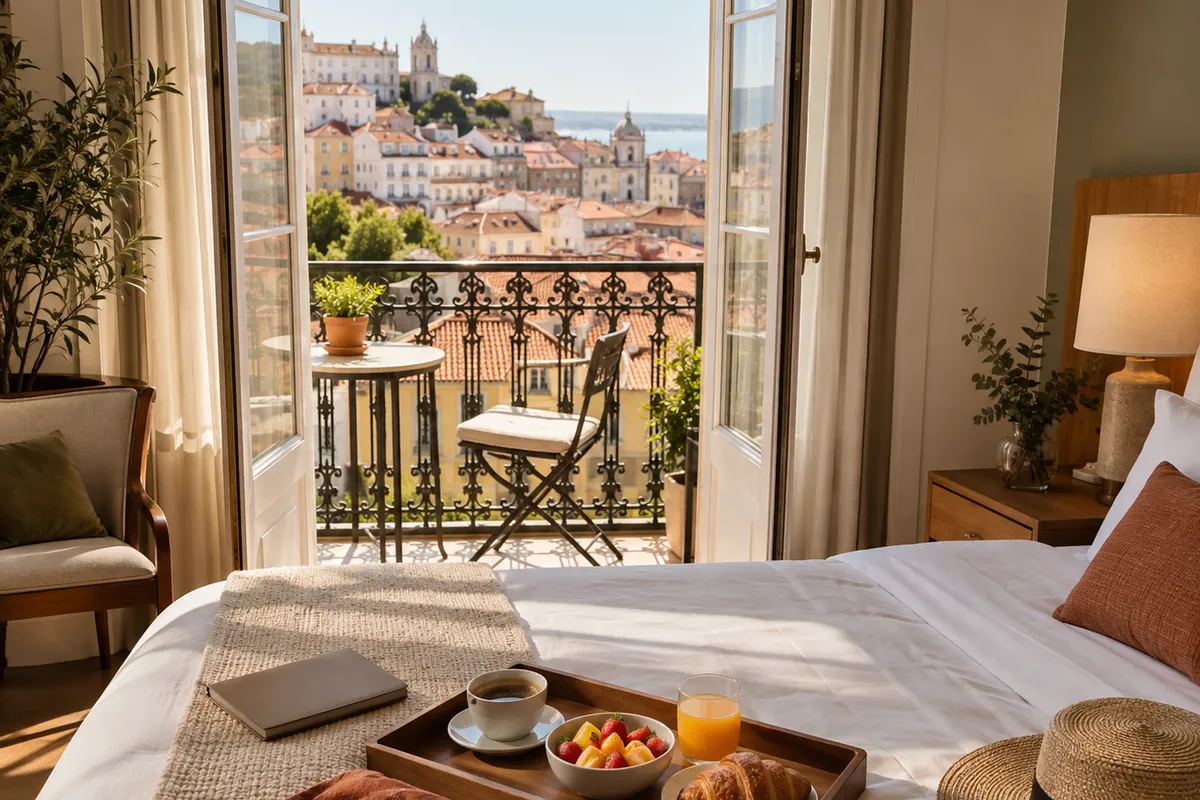
A standard hotel rating in Lisbon rarely tells you what will happen when you step out of the taxi. After walking the city's ridge paths and testing every transport connection for over seven years, I have seen hundreds of travelers struggle on their first morning because their accommodation sat halfway up a flight of limestone stairs or directly above a weekend bar cluster. Choosing between accommodation options requires looking past staged lobby photography to evaluate street gradients, nighttime decibels, and terminal connections.
Finding the right base among Lisbon hotels: a practical shortlist for different trips means matching your daily walking habits and arrival schedule with the physical realities of the city's seven hills. A quiet boutique property in a medieval alley offers panoramic morning light, but it also means carrying your suitcases over slick stone steps. Meanwhile, a business high-rise near the rail terminal provides step-free curbs and fast metro access, but sits miles from historic viewpoints.
Understanding Lisbon Hotel Costs, Taxes, and Mandatory Check-In Rules
Real-World Room Rates Across Tiers and Seasonal Price Swings
Hotel pricing in the Portuguese capital shifts dramatically between the winter trough and the extended summer peak. During regular travel months, a standard double room in a 3-star Lisbon hotel typically averages €140 to €160 ($150 to $175) per night, with breakfast usually included. Moving up to a 4-star property brings nightly averages to €200 to €225 ($220 to $245) per night during high and shoulder seasons, reflecting higher demand for central air-conditioned rooms with elevator access.
Five-star accommodation across central neighborhoods averages €315 to €375 ($345 to $410) per night, with rates reaching their highest points during May, June, and September. Travelers arriving during the winter low season in January and December find budget hotel rates across the city dropping to baseline rates between €64 and €90 ($70 to $100) per night. This makes midwinter an economical window for travelers unbothered by intermittent Atlantic rain.
| Hotel Tier | Regular / Peak Season Nightly Average | Winter Low Season (Jan / Dec) | Typical Inclusions |
|---|---|---|---|
| 3-Star Property | €140 – €160 ($150 – $175) | €64 – €90 ($70 – $100) | Buffet breakfast, en-suite bathroom |
| 4-Star Property | €200 – €225 ($220 – $245) | €110 – €140 ($120 – $155) | Elevator, mini-fridge, 24-hour reception |
| 5-Star Property | €315 – €375 ($345 – $410) | €190 – €240 ($210 – $265) | Valet drop-off, concierge, pool or spa |
During the annual Festas de Lisboa (Santos Populares), culminating on the night of June 12 to 13 (Dia de Santo António), citywide demand spikes. Central boutique hotels and registered holiday apartments (Alojamento Local) enforce strict minimum stays and room rates jump by 50% to 100%, with street parties closing roads until sunrise.
Municipal Tourist Taxes and Mandatory SIBA Legal Registration
Lisbon enforces a mandatory municipal tourist tax known as the Taxa Municipal Turística. As formalized by the Lisbon City Council in Notice no. 18684/2024/2, this fee doubled from €2 to €4 per guest aged 13 and over per night on September 1, 2024. The fee is capped at seven consecutive nights, meaning the maximum tax payable is €28 per person per stay. Hotels, guesthouses, and private rentals collect this fee directly at check-in or check-out.
Under Portuguese Law 23/2007 (Articles 15 and 16), all commercial lodging operators must submit guest identity data to the immigration authorities via the official SIBA portal within three working days of arrival. This legal obligation replaced older police paper cards and is monitored by the border and asylum agency AIMA (Agência para a Integração, Migrações e Asilo). To complete the mandatory SIBA bulletin, reception staff must inspect identification for every traveler.
Hotels must register every individual in your group regardless of age. Adults, teenagers, and infants must present physical passports or official national identity cards at the desk; digital photos or booking confirmation vouchers are legally rejected.
Older Building Trade-Offs: Elevators, Footing, and Climate Control Realities
Much of central Lisbon was rebuilt after the 1755 earthquake using the Pombaline cage (*gaiola pombalina*), an internal timber frame designed to absorb seismic shock. These structural wooden trusses and massive ground-floor stone arches make retrofitting elevator shafts challenging. In converted historic buildings across the old quarters, lifts often start on the mezzanine landing, forcing guests to carry luggage up an initial run of six to twelve steps.
Lisbon's iconic mosaic pavements (calçada portuguesa) are chiseled from basalt and limestone setts. While visually distinctive, these hand-laid stones have been polished smooth by decades of pedestrian foot traffic and become exceptionally slippery during autumn and winter rains. Approaching a hillside guesthouse on a 15% incline requires rubber-soled shoes with aggressive grip, particularly when pulling a two-wheeled suitcase behind you.
Centralized climate control in historic properties presents another seasonal hurdle. Many vintage buildings utilize two-pipe water chiller systems that switch between heating and cooling only twice per year. During transition months like April and October, hotel management may lock systems into heating mode or switch them off entirely, leaving guest rooms warm during unseasonably sunny afternoons despite adjustable wall thermostats.
Neighborhood Architecture: Finding Your Base on Lisbon's Seven Hills
Baixa, Chiado, and Rossio: Flat Corridors and High Walkability
Baixa is the flattest central neighborhood in Lisbon, laid out in an orderly grid between the Tagus riverfront and Praça de D. Pedro IV. For travelers traveling with pushchairs, bulky rolling suitcases, or reduced physical stamina, this district eliminates the need to climb steep urban gradients. You can review detailed quarter-by-quarter characteristics in our guide on choosing where to stay in Lisbon.
Adjoining Baixa to the west, Chiado sits on an elevated slope filled with theaters, department stores, and historic cafes. The district offers high walkability and immediate access to cultural sites, but moving between Baixa and Chiado requires navigating steep outdoor inclines. Direct connections to suburban day-trip trains depart from Rossio station at the base of the hill, making this central junction a strategic launchpad for rail excursions.
To avoid climbing the steep slope between lower Baixa and upper Chiado with day packs, enter the Baixa-Chiado metro station on Rua da Vitória and take the series of underground escalators straight up to Largo do Chiado for free without passing through the fare gates.
Alfama vs. Bairro Alto: Romantic Views, Steep Alleys, and Nightlife Noise
Alfama survived the 1755 earthquake, leaving its dense medieval maze of alleys, stone stairs (*escadinhas*), and blind courtyards intact. Most residential passages are completely pedestrianized and physically closed to cars, delivery vans, and taxis. If your hotel sits in the lower or mid-tier of Alfama, drivers must discharge you at perimeter viewpoints like Miradouro de Santa Luzia or Largo das Portas do Sol, requiring you to haul luggage down uneven stone staircases.
Bairro Alto occupies the high ridge above Chiado, operating as a quiet, sleeping residential grid by day and an open-air entertainment district by night. Rua Nova do Carvalho (widely known as Pink Street) down in Cais do Sodré and the central lanes of Bairro Alto host hundreds of bars where outdoor drinking continues past 04:00 on Friday and Saturday nights. Sleeping in these zones requires accommodation with acoustic soundproofing and double glazing.
Avenida da Liberdade and Príncipe Real: Upscale Boulevard Stays and Garden Enclaves
Avenida da Liberdade is Lisbon's premier luxury hotel corridor, designed in the nineteenth century as a wide, tree-lined boulevard modeled after Parisian avenues. The terrain along this grand axis is gentle and wide, paved with spacious sidewalks that allow luggage to roll freely. Direct metro transport runs along the Linha Azul (Blue Line) via Avenida and Marquês de Pombal stations, whisking passengers straight to historic central squares or northwest transit terminals.
Sitting directly west along the upper ridge, Príncipe Real is an upscale residential district anchored by 19th-century mansions, botanical gardens, and independent design boutiques. The neighborhood offers an authentic residential feel with quiet side lanes, but it lacks direct metro connectivity. Reaching Príncipe Real on foot from the central downtown valley requires climbing a sustained 15% grade, meaning visitors rely on buses, rideshares, or the steep Ascensor da Glória funicular.
| Neighborhood | Topography & Incline | Luggage Handling | Primary Transport | Dominant Nighttime Vibe |
|---|---|---|---|---|
| Baixa | Completely flat river basin | Effortless on flat sidewalks | Metro Blue/Green lines, flat walking | Moderate; quiet after retail stores close |
| Chiado | Moderate to steep slope | Requires hill climbs or escalators | Baixa-Chiado metro, Rossio train hub | Lively dining and theater crowds |
| Alfama | Extreme stairs, steep alleys | Difficult; manual carrying mandatory | Tram 28E, perimeter taxis only | Fado taverns, quiet residential core |
| Avenida da Liberdade | Very gentle boulevard incline | Effortless curbside drop-offs | Metro Blue Line (Avenida, Marquês) | Quiet, upscale corporate and diplomatic |
| Príncipe Real | High ridge hilltop | Moderate; mostly flat on ridge spine | Buses, Glória funicular, taxis | Chic wine bars, relaxed dining |
Lisbon Hotels: A Practical Shortlist for Different Trips and Travel Styles
The First-Timer Shortlist: Central Transit Access and Luggage-Friendly Approaches
For visitors exploring Portugal's capital for the first time, ease of orientation and uncomplicated luggage logistics should dictate hotel choice. Basing yourself within walking distance of Rossio station and major metro transfer points prevents exhausting transfers on arrival and departure days.
- Hotel da Baixa (Rua da Prata, 231): Features a completely flat street entrance directly off the pedestrian grid, with modern elevators serving all guest room floors. The property maintains an adapted mobility room on the first floor. Note that private car traffic is restricted along Rua da Prata; taxi and rideshare drivers drop passengers at Praça da Figueira, roughly 100 meters away across flat stone pavement.
- Santa Justa Hotel (Rua dos Correeiros, 204): Positioned on a level pedestrian corridor in the Pombaline grid, offering a zero-step entrance threshold and a modern internal elevator. The property sits less than a four-minute walk from Rossio station, allowing travelers to reach morning day-trip trains to Sintra without navigating hills.
- Heritage Avenida Liberdade (Avenida da Liberdade, 28): Housed in an 18th-century townhouse directly along the flat main boulevard, featuring a mechanized platform lift at the entryway and modern elevators throughout. Taxis and airport transfers can pull up directly to the front entrance for curb-level bag handling.
The Short-Break and Business Shortlist: Parque das Nações and Airport Corridors
Travelers arriving on late international flights, attending conferences, or planning 24-hour stopovers benefit from the modern infrastructure of Parque das Nações and the airport perimeter. This area eliminates historic building quirks in favor of wide roads, reliable elevators, and rapid connections via the Linha Vermelha (Red Line).
- Meliá Lisboa Aeroporto: Located approximately 200 meters from the front doors of Terminal 1 at Humberto Delgado Airport (LIS). Guests arriving late at night can bypass public transit, taxis, and shuttle queues entirely by walking directly across the pedestrian crosswalk to check in.
- Tivoli Oriente Lisboa Hotel (Av. Dom João II, 27): Situated just 170 meters from Gare do Oriente, this high-rise business hotel provides step-free access and fast passenger elevators. The property sits exactly three direct metro stops from the airport terminal on the Red Line, making arrival simple.
- Meliá Lisboa Oriente (Av. Dom João II): Located opposite the multimodal train and bus terminal at Gare do Oriente, this hotel provides direct vehicular drop-off for taxis and full accessibility. It sits adjacent to the flat Tagus riverside promenade, providing level running routes for fitness-minded guests.
The Romantic and Character Shortlist: Viewpoints, Boutique Stays, and Quiet Pockets
Travelers seeking historic architecture and Tagus river panoramas can find atmospheric boutique properties tucked away in ancient quarters, provided they accept physical access trade-offs. Checking for quiet interior orientations and independent reversible air conditioning compressors ensures comfort across changing seasons.
- Memmo Alfama (Travessa das Merceeiras, 27): An adults-only boutique retreat hidden inside the Moorish quarter, featuring a river-facing rooftop terrace and plunge pool. The hotel has an interior lift, but vehicular access is completely barred; taxis drop guests at Miradouro de Santa Luzia, leaving a 200-meter walk over sloped cobblestones and shallow steps.
- Memmo Príncipe Real (Rua D. Pedro V, 56J): A discreet, contemporary property positioned down a narrow residential alleyway off the district's main garden spine. It offers panoramic valley views, high-grade acoustic glass, and full step-free access and elevators throughout its modern architectural envelope.
- Casa Balthazar (Rua do Duque, 26): A tranquil historic estate tucked into the upper slopes of Chiado near the Carmo Convent ruins, complete with a private garden and heated outdoor pool. The historic townhouse layout requires climbing the stepped side alleyways of Rua do Duque to reach the gate from Rossio.
Transit Logistics: Connecting Lisbon Airport (LIS) to Your Hotel Door
Airport-to-Hotel Transit: Metro Red Line vs. Taxis and Ride-Hailing
Humberto Delgado Airport (LIS) sits unusually close to the urban core, connecting directly to the city transit network via the Aeroporto metro station at Terminal 1. The Linha Vermelha (Red Line) provides trains every 6 to 9 minutes, taking approximately 20 minutes to reach major junction stations like Alameda (transfer to the Green Line for Baixa) and Saldanha (transfer to the Yellow Line). Travelers should note that the dedicated airport express shuttle (Aerobus) has been permanently discontinued, leaving scheduled metro trains, city buses, taxis, and rideshare apps as your transport choices. If you want a step-by-step breakdown of terminal exits and luggage handling, read our detailed guide to Lisbon Airport transfers.
Official metered taxis queue directly outside the Terminal 1 arrivals hall at street level. A daytime taxi ride into central districts costs between €10 and €15 under normal traffic conditions, rising to €15 to €25 at night or during peak rush-hour gridlock. An official mandatory surcharge of €1.60 per trip applies whenever luggage larger than 55×35×20 cm is transported, whether stowed in the trunk or carried inside the cabin.
If you summon an Uber or Bolt at the airport, the vehicle will not meet you at the arrivals curb. By airport authority regulation, TVDE ride-hailing pickups are legally restricted to the designated commercial rideshare zone inside Parking P2 (Level 2, Arrivals level), accessible via the terminal footbridge. Fares to central districts range between €10 and €18 ($11 to $20).
| Transport Option | Typical Cost to Center | Average Travel Time | Boarding Location at LIS | Luggage Constraints |
|---|---|---|---|---|
| Metro (Red Line) | €1.90 (+ €0.50 card fee) | 25 – 35 min (with transfer) | Aeroporto station (Terminal 1) | Self-carry on turnstiles/escalators |
| Official Metered Taxi | €10 – €15 (Day) / €15 – €25 (Night) | 15 – 25 min | Arrivals forecourt curb (Terminal 1) | €1.60 flat fee for bags >55×35×20 cm |
| Ride-Hailing (Uber/Bolt) | €10 – €18 ($11 – $20) | 15 – 30 min | Parking P2, Level 2 exclusively | Standard vehicle trunk capacity |
Ticketing Strategy: Navegante Occasional Cards, Contactless Taps, and Lisboa Card
Lisbon public transport fares are unified under the municipal transit framework. In 2026, a single Carris/Metro transit ticket costs €1.90 for 60 minutes of travel across the network, according to official fare structures published by Metropolitano de Lisboa. To load this fare, every passenger must purchase a reusable Navegante occasional card for a one-off fee of €0.50. This green paper card is strictly individual; you cannot validate multiple travelers on a single card.
For visitors making only one or two isolated subway trips, bank cards and mobile wallets can tap directly at Lisbon metro ticket gates for a single journey fare of €1.92, bypassing ticket vending machines and eliminating the €0.50 paper card fee entirely. If you plan an intensive day of sightseeing across trams, buses, and elevators, the official Carris/Metro 24-hour pass costs €7.25. It grants unlimited access across urban buses, vintage streetcars, the Santa Justa Lift, funiculars, and the subway.
The €7.25 Carris/Metro day pass covers municipal transit, but it does not cover CP suburban commuter trains running out to Sintra or Cascais. If your plans include suburban monuments alongside city transit, the official Lisboa Card (€27 for 24h, €44 for 48h, €54 for 72h) covers all Carris and Metro routes, CP suburban trains to Sintra and Cascais, and includes entry to major city museums.
The Practical Lisbon Hotel Checklist: Room Amenities and Pitfalls
Acoustic Soundproofing and Double Glazing: Street Noise vs. Interior Patios
Lisbon's vintage streetcars add character to the streetscape, but properties located along active tracks face distinct acoustic challenges. Historic two-axle Remodelado trams on line 28E and modern articulated low-floor vehicles on line 15E produce metallic screeching on tight track bends, alongside low-frequency vibrations that transfer through building masonry. Properties at track junctions, such as Rua da Conceição or Largo do Martim Moniz, require modern window insulation to ensure undisturbed sleep.
Nightlife presents another source of nocturnal disturbance. Street drinking around Cais do Sodré and Bairro Alto regularly continues until 04:00 on weekends. When booking accommodation within 150 meters of active nightlife streets, look for verified acoustic soundproofing and double glazing. Requesting an interior-facing room (*quarto interior*) or an upper-floor unit facing a rear lightwell provides quiet conditions, though it may sacrifice daylight.
Heating, Cooling, and Mobility: Navigating Historic Renovations
Before confirming an accommodation booking in an older neighborhood, verifying three specific physical details with the front desk will prevent arrival disappointments:
- Direct Street-Level Lift Access: Ask whether the building's elevator connects directly to the street entrance without intermediate stairs, or whether you must carry luggage up a flight of stone steps to reach the elevator vestibule.
- Autonomous In-Room Cooling: Confirm whether the property uses independent split-system reversible air conditioning that allows guests to cool their rooms during warm shoulder weeks in April and October, rather than a building-wide system locked to heating.
- Front-Door Vehicle Drop-Off: Clarify whether regular taxis and ride-hailing drivers can stop immediately outside the front door, or if local municipal bollards and pedestrian zoning force a walking approach over cobblestones.
Walking around historic quarters also demands preparation for unpredictable road surfaces. When packing for Lisbon, leave smooth leather-soled shoes at home. Navigating polished, wet calçada portuguesa setts across inclines ranging from 10% to 18% requires shoes with textured rubber outsoles.
Final Verdict: The Decision Matrix for Your Lisbon Base
The Traveler-Profile Match: Choosing Between Central Buzz, Comfort, and Convenience
Selecting the best neighborhood base comes down to matching your personal mobility requirements and schedule constraints against Lisbon's topography:
- Families with Young Children and Heavy Luggage: Select Baixa. The completely level post-earthquake street grid allows pushchairs and heavy suitcases to roll without resistance, while providing immediate step-free access to flat metro connections and grocery stores.
- Travelers Prioritizing Spacious Rooms and Easy Transfers: Select Avenida da Liberdade. The broad boulevard layout supports direct vehicle drop-offs at the curb, while 4- and 5-star properties offer reliable elevators, larger floorplans, and direct access to the Blue Line.
- Couples Seeking Historic Character and Scenic Views: Choose Alfama or Príncipe Real. The intimate alleyways, tile-clad facades, and river vistas deliver traditional atmosphere, provided you are prepared to manage pedestrian stairways and carry bags over stone streets.
- Short Stopovers, Dawn Departures, and Business Trips: Choose Parque das Nações or the airport perimeter. Properties here feature modern acoustic isolation, reliable high-speed Wi-Fi, step-free access, and a short 10-minute metro or taxi connection to terminal departure gates.
The Pre-Booking Sanity Check: Avoiding Last-Minute Arrival Surprises
To ensure a seamless arrival from the airport to your room, complete these four checks before finalizing your booking:
- Gather physical passports or national identity cards for every member of your party—including infants—so the front desk can complete the mandatory SIBA bulletin required by AIMA without check-in delays.
- Keep credit cards or cash ready for the municipal tourist tax (Taxa Municipal Turística), which costs €4 per person per night (for guests 13 and older, up to seven nights) and must be paid directly to the accommodation.
- If ordering an Uber or Bolt at Humberto Delgado Airport (LIS), walk to the designated pickup bays on Level 2 of Parking P2 rather than waiting at the arrivals curb.
- Examine the street entrance on a satellite map to confirm whether your hotel sits on an inaccessible pedestrian stairway, allowing you to pack appropriate footwear and luggage.