
A morning excursion from central Lisbon to Belém often turns into an exercise in frustration if you step onto the wrong transit platform or join the wrong queue. During my seven years living in Lisbon, I have watched thousands of independent visitors waste hours waiting on crowded tram boarding islands or standing in line outside monuments when their destination was either free or had a separate entrance. Planning your visit around verified transit routes, exact ticket rules, and realistic walking distances transforms what could be an exhausting day into an efficient cultural route along the Tagus River waterfront.
Belém holds some of Portugal's most significant Manueline architecture, historic riverside landmarks, and modern art institutions, but it also carries heavy visitor bottlenecks. In this Belém guide, you will find direct transit timings, step-by-step entry protocols for the major national monuments, and practical advice to help you navigate the district on your own terms.
Getting to Belém: Transit Options, Route Bottlenecks, and Ticket Costs
Reaching Belém from Lisbon's historic core requires crossing roughly six kilometres of urban riverfront. While travel brochures routinely suggest taking the historic tram, street-level congestion and passenger surges make that choice one of the slowest ways to travel. Choosing the right transit mode depends on whether you value speed, cost, or personal space.
Choosing Between the CP Cascais Train and Elétrico 15E
The fastest and most reliable way to travel from central Lisbon to Belém is the suburban commuter railway operated by Comboios de Portugal. Trains depart from terminal platforms 1 through 4 at Cais do Sodré station along the Cais do Sodré Cascais train line. In 2026, a single zone-1 adult ticket costs €1.50, and the journey to Belém station takes approximately 7 minutes. The trains run every 12 to 20 minutes throughout the day, bypass all road traffic along Avenida 24 de Julho, and offer wide passenger cars with minimal crowding outside weekday rush hours.
In contrast, Carris Tram Elétrico 15E departs from the southern riverbank side of Praça do Comércio and takes between 25 and 40 minutes to reach Mosteiro dos Jerónimos, depending on street traffic and delivery vans blocking the tracks. Purchasing a single paper ticket on board the tram from the driver or on-board machine costs €3.30 in 2026. The tram suffers from severe crush loading, long boarding queues in the midday sun, and targeted pickpocketing activity between Cais do Sodré and Alcântara. I avoid the 15E tram whenever I need to reach Belém on a fixed schedule.
If you prefer a surface bus rather than rail, Carris bus route 728 provides a superior alternative to the tram. The 728 runs double-length articulated, air-conditioned buses that connect Santa Apolónia station and Praça do Comércio directly to Belém and Restelo. It runs along the dedicated bus corridor, carries higher passenger volume, and rarely experiences the severe bottlenecks common to the tram line.
In 2026, travelling on Carris Tram 15E or CP suburban trains without a validated ticket is a serious administrative violation under Law 28/2006 (republished by Decree-Law 117/2017). Statutory fines range between €120.00 and €350.00. Settling the infraction voluntarily within 15 business days applies a 50% reduction, lowering the minimum fine to €60.00.
Transit Fares: Navegante Zapping vs. 24-Hour Passes and the Lisboa Card
Selecting the right fare category prevents unnecessary spending at ticket machines. In Lisbon, urban transit uses the rechargeable paper Navegante card, which carries a €0.50 initial purchase fee. You can load this card with pay-as-you-go credit known as Zapping, load a 24-hour network pass, or opt for the tourist-oriented Lisboa Card.
A Carris and Metro 24-hour pass costs €7.25 in 2026 and covers all urban buses, funiculars, metro lines, and trams across the city network. Comparing this pass against individual fares clarifies when it makes financial sense. If you pay on board the tram with cash at €3.30 per journey, the daily pass pays for itself on your third ride. However, if you use a Navegante Zapping card, each Carris journey costs €1.72 and each CP train ride to Belém costs €1.50. Against Zapping rates, the €7.25 daily pass only reaches break-even on your fifth trip of the day (€7.25 divided by €1.72 equals 4.2 journeys).
| Transit Method & Ticket Type | One-Way Adult Fare | Transit Time | Where to Validate |
|---|---|---|---|
| CP Cascais Train (Zapping) | €1.50 | 7 minutes | Station platform turnstiles / yellow post boxes |
| CP Cascais Train (Paper Zone-1) | €1.50 | 7 minutes | Station platform turnstiles / yellow post boxes |
| Elétrico 15E Tram (On-board cash) | €3.30 | 25–40 minutes | Inside tram cabin at yellow door readers |
| Elétrico 15E Tram (Zapping) | €1.72 | 25–40 minutes | Inside tram cabin at yellow door readers |
| Carris Bus 728 (Zapping) | €1.72 | 15–20 minutes | Inside bus cabin at entrance validator |
| Carris/Metro 24-Hour Pass | €7.25 (+ €0.50 card) | Varies by route | At boarding point before every ride |
The official Lisboa Card provides an alternative for heavy museum days. In 2026, the card costs €31 for 24 hours, €51 for 48 hours, and €62 for 72 hours. It grants unlimited travel on Carris vehicles, the metro, and the CP Cascais train line, while covering entry fees to Mosteiro dos Jerónimos, Torre de Belém, and the Museu Nacional dos Coches. It only saves you money if you plan to enter at least two paid national monuments on the same calendar day.
Remember the difference in validator placement: Carris buses and trams have yellow ticket readers mounted directly inside the vehicle doors. CP commuter trains require you to tap your Navegante card at the yellow pedestal validators on the station concourse before stepping onto the boarding platform.
Belém Monuments: Exploring Jerónimos Monastery and Santa Maria Church
Mosteiro dos Jerónimos stands as the primary example of Manueline architecture in Portugal, combining late Gothic structures with intricate nautical and naturalistic carvings. The monument splits into two distinct sections: the ticketed cloisters and the free parish church. Understanding how these entrances function prevents you from waiting in the wrong line.
Jerónimos Monastery Cloisters: Online Time Slots, Luggage Restrictions, and Closures
Visiting the two-tier Jerónimos Monastery cloisters requires an official timed-entry ticket booked in advance. Under the official pricing structure of Museus e Monumentos de Portugal, standard adult admission is €18.00. Entry vouchers are issued with a strict 30-minute arrival window. If your ticket lists 10:00, staff will allow you through the scanning gates only between 10:00 and 10:30. Visitors who miss their timed window are directed away from the priority scanning queue.
Security staff enforce a strict restriction on luggage and oversized bags. Any bag, backpack, or rolling case exceeding 30 by 30 centimetres is banned from the monument. There are no luggage storage lockers or cloakrooms anywhere on the monastery grounds. If you arrive from the airport or with transit luggage, you will be turned away at the door. You must leave large bags in automated storage lockers near Cais do Sodré or Belém train station before walking to Praça do Império.
Be aware that the former museum wing on the western perimeter of the monastery complex is inactive. The Museu Nacional de Arqueologia, which historically occupied this wing, remains closed to the public for comprehensive structural and museological refurbishment funded under the national Recovery and Resilience Plan (PRR). All cloister access enters through the central entrance portal facing the formal gardens.
National monument policies reserve free Sunday museum entry strictly for Portuguese citizens and legal tax residents. Foreign tourists must pay the standard €18.00 admission fee on Sundays. If you are structuring a broader route across the capital, check our three days in Lisbon itinerary to see where Belém fits best into your week.
Santa Maria de Belém Church: Free Access, Royal Tombs, and Mass Schedules
Directly adjacent to the cloister entrance stands the Church of Santa Maria de Belém. Many independent travellers stand in the cloister ticket line for an hour under the mistaken impression that they must pay to see the church interior. Admission to Santa Maria de Belém is completely free and operates through a separate queue at the south-eastern entrance portal.
Inside the nave, the vaulting rises over slender stone columns carved with Renaissance motifs. Immediately to the left of the main entrance rests the neo-Manueline tomb of explorer Vasco da Gama, who set sail for India from the shores of Belém in 1497. Opposite his tomb, on the right side of the lower nave, lies the matching stone sarcophagus of poet Luís de Camões, whose epic work Os Lusíadas chronicled Portuguese maritime expeditions.
Walking deeper into the church leads to the Classical chancel (capela-mor), redesigned by architect Jerónimo de Ruão in the late 16th century. Here, the royal tombs of King Manuel I, his wife Maria of Aragon, King João III, and Queen Catherine of Austria rest on sculpted marble elephants set into arched wall niches.
You must schedule your church visit around Roman Catholic liturgical services. Santa Maria de Belém remains an active parish church. Tourist access closes completely during Sunday morning masses and state ceremonies. On Sundays, tourist entry opens strictly from 14:00 to 17:00. During weekday religious ceremonies, staff restrict sightseeing access to maintain quiet in the nave.
Tagus River Waterfront Icons: Torre de Belém and Padrão dos Descobrimentos
Leaving the monastery grounds and walking south toward the Tagus brings you to Belém's defensive and commemorative monuments. Because these riverfront structures stand on exposed waterfront embankments, physical bottlenecks and weather conditions heavily influence visiting hours.
Torre de Belém: Crowd Caps, Interior Congestion, and Entry Logistics
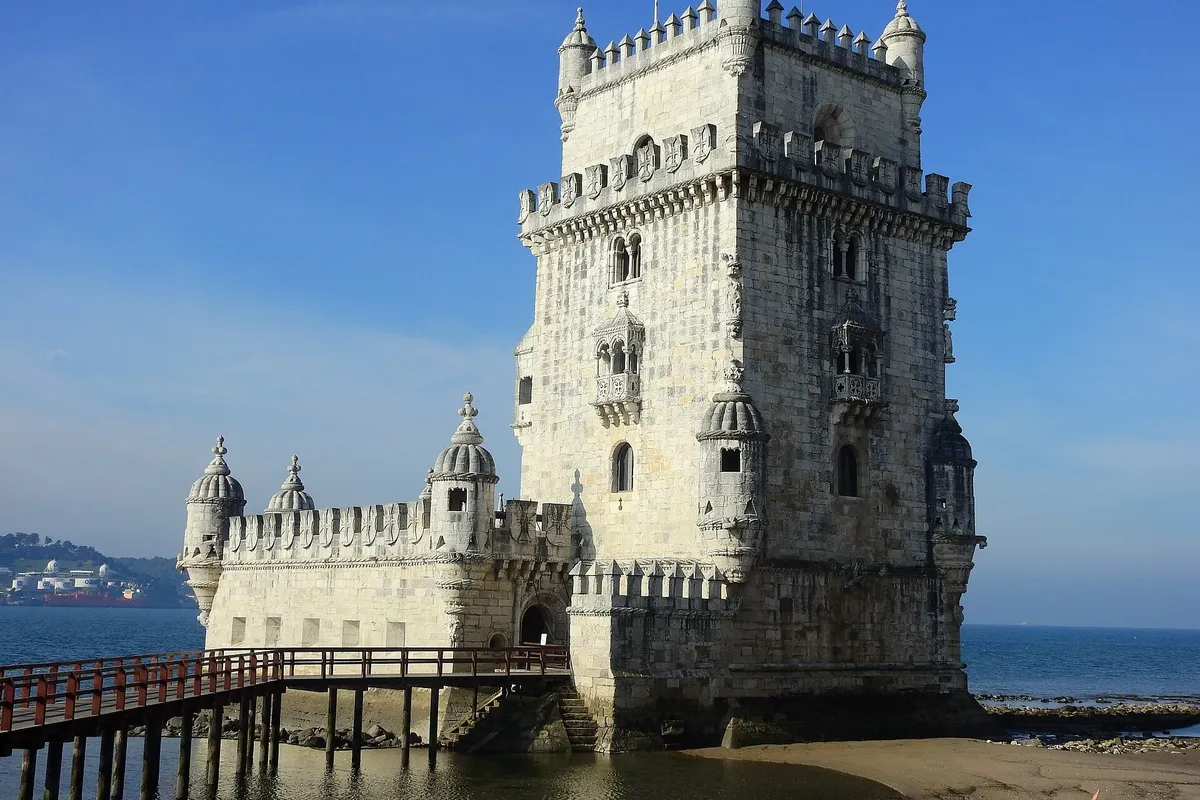
Torre de Belém was built between 1514 and 1519 in the middle of the Tagus estuary to protect Lisbon's anchorage. Due to shoreline shifts over the centuries, the fortress now sits close to the riverbank, linked by an elevated wooden footbridge. Standard adult admission to the fortress interior is €15.00 when booked online through Museus e Monumentos de Portugal.
The interior operates under a mandatory safety limit of 120 visitors at any one time. Access throughout the four-storey tower relies on a single, narrow spiral staircase where two-way passage is physically impossible. Staff manage foot traffic using automated red and green traffic lights at each floor landing. During peak midday hours, waiting for a green light on a crowded intermediate landing can take 15 to 20 minutes in humid conditions.
Inside, the layout includes the lower Casemate (Sala dos Canhões) featuring 16 cannon embrasures, followed by the Governor's Chamber (Sala do Governador), the King's Hall, the Audience Chamber, a fourth-floor chapel, and the upper open-air battlement. The interior stone chambers contain very little furniture or interpretive signage. From an architectural perspective, the exterior view of the Manueline rope carvings, balconies, and Moorish watchtowers from the surrounding public park provides better photographic value than waiting in line to climb the damp stairwell.
If you choose to enter Torre de Belém, reserve the earliest 09:30 morning slot online. Midday slots between 11:30 and 15:30 generate severe staircase delays that consume more time than the rooms warrant.
Padrão dos Descobrimentos and Praça do Império: Rooftop Views and Underpasses
Standing east of the fortress along the riverbank, the Padrão dos Descobrimentos rises 56 metres over the water. Built in its permanent concrete and limestone form in 1960, the monument takes the shape of a ship's prow, led by the figure of Henry the Navigator followed by 32 historical figures representing navigators, cartographers, chroniclers, and monarchs.
Reaching the monument from the monastery requires careful route planning. Avenida da Índia and the parallel Cascais railway line feature solid concrete crash barriers and continuous rail tracks that block all surface crossings. Pedestrians must use the paved underground subway underpass located on the southern edge of Praça do Império. Walking down through this underpass brings you directly to the riverside plaza without risking traffic.
At the base of the monument lies the 50-metre South African marble Rosa dos Ventos compass rose set into the pavement, charting the routes and dates of Portuguese voyages. Entering the monument offers two ticket tiers: an exhibition-only ticket for €5.00, or a full-access ticket covering the temporary galleries and the elevator ride to the 56-metre rooftop observation deck for €10.00.
The rooftop terrace provides an unobstructed 360-degree panorama of the Jerónimos complex, the Tagus estuary, and the 25 de Abril Bridge. However, maritime safety regulations mandate that the elevator and open-air rooftop close without advance notice whenever Tagus gale warnings or high wind speeds create hazardous conditions on the top platform.
Arts and Heritage: Modern Collections and Historic Carriages in Belém
Beyond its maritime monuments, Belém serves as one of Lisbon's premier museum quarters. Its institutions house global transport collections, industrial installations, and major modern art holdings within walking distance of the riverfront.
Museu Nacional dos Coches: Main Pavilion vs. Picadeiro Real Coach Hall
The Museu Nacional dos Coches holds the world's most extensive collection of ceremonial horse-drawn carriages, tracing the evolution of royal transport from the late 16th to the early 20th century. Standard adult admission to the main modern building costs €15.00 under Museus e Monumentos de Portugal.
The collection occupies a white concrete pavilion designed by Pritzker laureate Paulo Mendes da Rocha in collaboration with Ricardo Bak Gordon. The spacious, fully air-conditioned exhibition halls offer a comfortable indoor retreat during summer heatwaves, with significantly lower visitor density than the monastery cloisters. Primary highlights include:
- The 1619 Traveling Coach of King Philip II: The oldest operational coach in the collection, constructed of wood and leather during Philip's royal visit from Madrid to Lisbon.
- The 1716 Oceans Coach (Coche dos Oceanos): A Baroque ceremonial carriage gilded in carved gold leaf, built in Rome for the embassy of the Marquis of Fontes to Pope Clement XI.
- 19th-Century Royal Berlins: Highly articulated carriages used by King Carlos I and Queen Amélia, showing the transition toward padded springing and glass carriage windows.
Take note of an important site restriction: the historic 18th-century Royal Riding Arena (Picadeiro Real coach hall), situated across the avenue at the former presidential palace grounds, is temporarily closed to the public for planned conservation and structural restoration works. All carriage visits currently take place exclusively within the modern pavilion at Avenida da Índia 136.
Industrial and Contemporary Art: MAAT Central Tejo and MAC/CCB
Visitors interested in 20th- and 21st-century culture have two distinct institutions along the Belém waterfront: the Museum of Art, Architecture and Technology (MAAT) and the Contemporary Art Museum at Centro Cultural de Belém (MAC/CCB).
MAAT occupies two physical facilities along the riverbank: the futuristic white-ceramic gallery designed by British architect Amanda Levete and the red-brick Central Tejo power station. A standard adult ticket covering both buildings costs €15.00 for non-residents of Portugal (€11.00 for legal residents). Inside the Central Tejo complex, you can walk through the preserved boiler rooms, machinery halls, and steam condensers that supplied Lisbon with electricity during the early 20th century, before stepping into contemporary design exhibitions in the new wing.
Directly opposite Praça do Império, the MAC/CCB operates inside the limestone Centro Cultural de Belém complex. Standard admission for international visitors is €15.00. The museum houses the State Contemporary Art Collection (CACE) alongside international modern pieces and features a newly renovated Architecture Centre displaying regular design retrospectives.
If you plan to visit multiple modern spaces, consider the CABE (Circuito Arte de Belém) pass sold via the BOL ticketing platform. This €28.00 combined pass covers MAAT, MAC/CCB, the Julião Sarmento Pavilion, and MACAM, offering a 20% discount compared to individual admissions and remaining valid for 90 days.
Belém Riverside Walks and Food Culture: Routes, Marinas, and Authentic Pastéis
Walking between monuments along the Tagus provides wide horizons, salty river breezes, and flat terrain, but the open layout requires sensible timing and route planning.
Navigating the Belém Riverside Promenade: Doca de Bom Sucesso to Central Tejo
The Belém riverside promenade offers a continuous, flat 2.4-kilometre pedestrian route linking Torre de Belém to Central Tejo. Walking the full distance at an easy pace takes roughly 30 to 35 minutes. Unlike the traditional cobbled streets of central Lisbon, this promenade features wide asphalt footpaths and timber decking running parallel to segregated cycling lanes.
Starting at Torre de Belém, the trail curves around Doca de Bom Sucesso marina, where sailing boats and river catamarans moor behind sheltered breakwaters. Continuing eastward past Doca de Belém brings you beneath the Padrão dos Descobrimentos, where outdoor marina terraces serve coffee and light lunches with open views of the 25 de Abril Bridge.
The entire riverfront walk has no tree canopy or shade structures. Between June and September, midday solar radiation off the Tagus can be punishing. Plan this walk for the morning before 11:00 or late afternoon after 16:30, and carry drinking water. The walk ends at the accessible rooftop ramp of MAAT, where pedestrians can climb the curving exterior of the building for an elevated view over the river.
Fábrica de Pastéis de Belém: Table Seating Tactics and the Annex Counter
No trip to the district is complete without stopping at the Fábrica de Pastéis de Belém on Rua de Belém. The bakery has operated continuously since 1837, baking pastries using a secret recipe originally acquired from the monks of Mosteiro dos Jerónimos following the dissolution of religious orders in Portugal.
A persistent travel myth causes hundreds of tourists to waste 45 minutes on the sidewalk. The massive queue stretching down the pavement outside the shop is exclusively for the takeaway counter. If you wish to sit down, walk past the exterior queue directly through the front doors into the interior halls. The café contains over 400 seats distributed across multiple blue-and-white tiled dining rooms.
During peak hours between 11:00 and 16:00, you may encounter a short indoor queue managed by an entry host, but table turnover is rapid and moves much faster than the exterior takeaway line. Table service incurs no price markup over takeaway purchases. In 2026, an individual warm tart costs €1.60, and a traditional boxed six-pack costs €9.60, served with separate shakers of ground cinnamon and powdered sugar.
To relieve sidewalk crowding during phased interior preservation work, the bakery opened a secondary annex counter nearby at Rua de Belém 68. If you want a quick box to eat in the gardens of Praça do Império and do not need a café table, buying at the annex counter saves substantial time.
Practical Planning and Trade-Offs: Schedules, Budgets, and Strategic Verdict
Coordinating opening days, transport rules, and realistic timing determines whether your day in Belém feels seamless or chaotic.
The Monday Conundrum: What Closes, What Operates, and Sunday Tariff Realities
Mondays cause widespread confusion among Lisbon visitors because European museums traditionally shut down at the start of the week. In Belém, national monuments follow strict operational schedules:
- Closed on Mondays: Mosteiro dos Jerónimos Cloisters, Torre de Belém, Museu Nacional dos Coches, and MAC/CCB.
- Open on Mondays: Padrão dos Descobrimentos (open daily), Church of Santa Maria de Belém (free entry), and the entire MAAT complex (which closes on Tuesdays instead).
If Monday is the only day you can visit Belém, you can still examine the exteriors of the fortress and monastery, enter the free Santa Maria church, ascend to the Padrão viewpoint, visit Central Tejo, and walk the waterfront promenade. However, if your goal is entering the famous cloisters or carriage collection, reschedule your visit for Wednesday through Sunday.
Regarding Sunday visits, do not rely on outdated blog posts claiming that all national museums are free. The Portuguese national policy granting 52 free admission days per calendar year is restricted to Portuguese citizens and verified legal residents registered with the tax authority. Non-resident international visitors must pay regular admission fees every day of the week, including Sundays.
Practical Belém Verdict: Route Selection Matrix and Time Allocation
To maximize your time and budget, organize your visit around one of two realistic itineraries:
- Half-Day Express (3.5 Hours): Board the CP train at Cais do Sodré before 08:45 to arrive at Belém station by 09:00. Enter the Jerónimos Cloisters at your pre-booked 09:30 time slot. At 10:45, enter the free Church of Santa Maria de Belém. Cross through the Praça do Império underpass to view the Padrão dos Descobrimentos and the Rosa dos Ventos paving. Finish with table service at Fábrica de Pastéis de Belém before taking the train back to central Lisbon.
- Full-Day Cultural Deep Dive (7 Hours): Complete the half-day morning route, then continue eastward to the modern pavilion of the Museu Nacional dos Coches. Break for lunch around the marina, then spend the afternoon exploring contemporary design at MAAT and Central Tejo. End your day walking up MAAT's public roof terrace for sunset over the Tagus. For practical planning across your wider trip, consult our recommendations on where to stay in Lisbon to pick the most convenient neighbourhood base.
| Attraction | 2026 Ticket Price | Strategic Recommendation | Key Logistical Rule |
|---|---|---|---|
| Jerónimos Cloisters | €18.00 | Must-do interior | Book 30-min time slot; no bags >30x30 cm |
| Santa Maria Church | Free | Must-do interior | Use separate right-hand queue; avoid Sunday mornings |
| Torre de Belém | €15.00 | Skip interior; view exterior | 120-person cap; single spiral stair bottlenecks |
| Padrão dos Descobrimentos | €10.00 (Rooftop) | Recommended viewpoint | Elevator to roof; closes during high Tagus winds |
| Museu dos Coches | €15.00 | Recommended cultural stop | Modern pavilion open; Picadeiro Real closed |
| MAAT & Central Tejo | €15.00 | Great afternoon stop | Closed Tuesdays, open Mondays; roof access free |
My verdict on the paid interiors is straightforward: pay €18.00 for the Jerónimos Monastery cloisters without hesitation, as the Manueline stone vaulting has no equal in Europe. Skip the €15.00 ticket to enter Torre de Belém; its interior rooms are largely barren, and waiting on staircases eats into your daylight. Instead, pay €10.00 to take the elevator up the Padrão dos Descobrimentos, which offers superior views of the river and monuments with none of the staircase congestion. Complete your day by following the waterfront promenade to Central Tejo as the afternoon light softens over the water.