
Stepping out into Lisbon for the first time usually means facing an immediate physical reality: steep limestone slopes, a complex transit network, and long queues at flagship monuments. Deciding which Lisbon attractions: what to see on your first visit should take priority comes down to understanding elevation, strict ticketing protocols, and neighborhood geography. During my seven years of mapping walking routes across these quarters, I have seen too many travelers exhaust themselves on mismatched transfers or get turned away at monastery gates without a valid reservation.
This guide provides a verified, logistical roadmap for your first trip. You will find exact entry fees, crowd patterns, public transit fare structures, and practical steps to bypass the worst tourist bottlenecks across the capital.
Lisbon Attractions: What to See on Your First Visit in the Historic Core
The historical spine of Lisbon sits across steep ridges overlooking the Tagus River. Managing your footing and knowing entry policies before climbing is essential to navigating this district efficiently.
Castelo de São Jorge and the Hilltop Miradouros
Perched atop the highest hill in the historic center, the fortified citadel of São Jorge defines the city skyline. According to the Castelo de São Jorge official website, general adult admission costs €17.00, visitors aged 13 to 25 pay €8.50, seniors aged 65 and over pay €14.00, while children under 13 enter free of charge. Unlike national monuments managed by the central state, the castle is operated by a municipal municipal company. Because of this, the standard Lisboa Card does not provide free admission here, which often catches first-time visitors off guard at the ticket booths.
If your primary goal is a panoramic view rather than walking the stone ramparts and shaded gardens, the surrounding public viewpoints offer exceptional alternatives without the entry fee. For an in-depth breakdown of the fortress layout and ticket queues, read our detailed guide on São Jorge Castle: how to plan your visit before you head up the hill.
| Viewpoint (Miradouro) | Elevation & Sightlines | Crowd Dynamics | Key Logistical Feature |
|---|---|---|---|
| Miradouro de Santa Luzia | Mid-slope; views over Alfama red roofs and Tagus estuary | High congestion mid-day; frequent street musicians | Shaded pergola with traditional blue azulejo tile panels |
| Miradouro da Senhora do Monte | Highest hill point; 250-degree panorama of castle and river | Moderate during the day; high at sunset | Steep uphill climb; fewer tour group crowds than lower terraces |
Castelo de São Jorge remains open seven days a week, making it one of the most reliable options to schedule on a Monday when most national state museums are closed across the city.
Exploring Alfama: Sé de Lisboa and Evening Fado Culture
Alfama is Lisbon’s oldest surviving quarter, an intricate maze of medieval alleys that survived the 1755 earthquake. At the lower entrance to the neighborhood stands the fortress-like Sé de Lisboa (Lisbon Cathedral). According to the Sé de Lisboa official ticketing desk, a comprehensive tourist ticket covering the high choir, the treasury museum, the central nave, and the ambulatory costs €7.00 for adults (€5.00 for Lisboa Card holders) and €5.00 for children aged 7 to 12, with free entry for children aged 6 and under.
In the evenings, Alfama shifts its rhythm toward traditional Fado music. First-time visitors should understand the clear division in performance formats before booking:
- Casas de Fado: Established dinner venues (such as Clube de Fado or Mesa de Frades) that require reservations 3 to 5 days ahead during peak months, featuring structured acoustic sets and mandatory minimum spends typically ranging between €50.00 and €75.00 per person.
- Tasca Fado Vadio: Casual neighborhood taverns (such as A Baiuca) where amateur singers perform spontaneously, operating on walk-in waiting lists or modest minimum orders between €15.00 and €35.00 for simple drinks and petiscos.
In traditional fado houses and neighborhood restaurants, table bread, olives, and cheese (the couvert) are placed on your table automatically. They are not complimentary; consuming them adds an extra €3.00 to €8.00 to your bill. Strict silence is expected while the fadista sings.
Conquering the Incline: Tram 28 Realities and Walking Routes
The iconic yellow vintage tram, Eléctrico 28, runs from Martim Moniz to Campo de Ourique, passing through the tight curves of Alfama and Graça. Paying on board directly to the driver with cash costs €3.30, and drivers regularly reject banknotes larger than €10.00 due to a lack of change. In contrast, pre-loading your journey onto a transit smartcard reduces the single fare to €1.90, or €1.72 using pay-as-you-go Zapping credit.
The romantic image of Tram 28 frequently clashes with intense operational realities. Between 09:30 and 18:00, queues at the Martim Moniz terminal routinely exceed 60 minutes, and the interior cabins become packed beyond seated capacity. Furthermore, crowded conditions make the route a frequent target for organized pickpocket teams. If you want to ride the historic Remodelado carriages with minimal stress, board before 08:30 or after 19:00, and keep your bags zipped across your chest.
For a scenic ride with noticeably shorter queues, consider Carris Tram 12E. It operates a circular loop between Praça da Figueira and Martim Moniz, traveling past the Sé Cathedral and Miradouro de Santa Luzia along the exact same historic tracks as the 28E.
Baixa Pombalina and Chiado: Grand Plazas, Elevators, and Architectural Scars
Rebuilt after the catastrophic 1755 earthquake on an enlightened grid plan, Baixa stands in sharp contrast to Alfama’s winding alleys. Directly uphill lies Chiado, the cultural and commercial heart of central Lisbon.
Praça do Comércio and the Grid of Baixa Pombalina
Opening directly onto the broad Tagus estuary, Praça do Comércio (historically known as Terreiro do Paço) served as the royal waterfront entrance for centuries. Walking through the monumental Arco da Rua Augusta brings you into the pedestrianized shopping corridor of Baixa. Access to the viewing platform atop the triumphal arch costs €3.50 (free with the Lisboa Card), offering a direct view down the symmetry of Rua Augusta toward Rossio.
While the wide boulevards are pleasant to walk, dining terraces directly on Rua Augusta cater aggressively to tourists. Waiters stationed on the pavement will try to steer you into outdoor tables displaying multilingual photo menus. Food prices along this central axis carry steep markups for mediocre quality, so I make it a rule to walk two blocks east or west into the residential cross-streets whenever I need a coffee or lunch.
Elevador de Santa Justa: Avoiding Tourist Traps and Long Queues
Connecting the flat grid of Baixa with the higher elevation of Carmo Square, the neo-Gothic iron Santa Justa Lift is an unmistakable engineering landmark. However, the street-level boarding booth on Rua de Santa Justa represents one of the worst time-sinks in the city, with wait times regularly stretching between 45 and 90 minutes in summer.
The fare structure also catches many travelers by surprise:
- Booth Ticket: Buying a round-trip ticket directly at the elevator cabin costs €6.20.
- Transit Card Inclusion: The ride is included at no extra charge if you hold a standard 24-hour Carris/Metro transit pass (€7.25) or an active Lisboa Card.
- Upper Observation Deck: Stepping onto the highest open-air lookout platform above the machine room requires an additional €5.00 fee, payable by card only, which is not covered by ordinary transit passes.
You can skip the 60-minute queue at the base entirely. Walk uphill through Chiado via Rua Garrett and Calçada do Sacramento to Largo do Carmo. From there, a public walkway leads directly onto the upper platform of the Santa Justa Lift for free.
Convento do Carmo Ruins and the Literary Streets of Chiado
Standing directly behind the upper lift platform are the skeletal stone arches of the Carmo Convent. The fourteenth-century Gothic church collapsed during the 1755 earthquake while morning mass was underway. Rather than rebuilding the roof, the city preserved the nave open to the sky as a permanent physical memorial, housing the Museu Arqueológico do Carmo inside the former chancel.
General admission to the Carmo Archaeological Museum costs €7.00 for adults, and €5.00 for students, seniors (65+), and Lisboa Card holders, while children up to age 14 enter free. Keep in mind that the ruins are closed on Sundays. After exploring the sunlit nave, take time to walk down Rua Garrett in Chiado. Here you will find Livraria Bertrand, verified by Guinness World Records as the oldest continuously operating bookstore in the world, founded on this street in 1732. For advice on booking accommodation within walking distance of Chiado's evening dining scene, explore our guide to where to stay in Lisbon: choosing the right neighbourhood.
Belém Waterfront: Manueline Architecture, Riverfront History, and Logistics
Located roughly six kilometers west of downtown Lisbon, Belém is the historic departure point for maritime expeditions during the Age of Discovery. It is home to Portugal’s finest Manueline stone architecture, as well as the city’s tightest monument entry regulations.
Mosteiro dos Jerónimos: Cloisters Booking Rules and Church Access
The Jerónimos Monastery is a masterwork of sixteenth-century Manueline design, funded historically by the maritime spice trade. Individual entry to the historic cloisters costs €18.00 when booked through the state agency Museus e Monumentos de Portugal (MMP). Because the cloisters operate under strict hourly capacity limits, all visitors—including holders of the Lisboa Card—must reserve an online timed-entry slot in advance. Turning up without a pre-booked time slot almost always results in refusal at the gate.
A critical operational mistake many travelers make is joining the wrong line outside the massive limestone facade. There are two entirely separate access points:
- The Church of Santa Maria de Belém: Located in the central nave containing the stone tombs of explorer Vasco da Gama and poet Luís de Camões. Entry here is completely free, and the queue forms to the right of the main portal.
- The Cloisters (Mosteiro): The paid historical complex entered via a designated lane to the left. If you stand in the church line for an hour expecting to enter the cloisters, museum staff will redirect you to the back of the ticketed line.
Under Portugal's cultural policy (Acesso 52), the 52 days of free weekend admission to national monuments are strictly limited to Portuguese citizens and foreign nationals holding legal Portuguese residency. International tourists must purchase full-fare tickets every day of the week.
Torre de Belém and Padrão dos Descobrimentos Along the Tagus
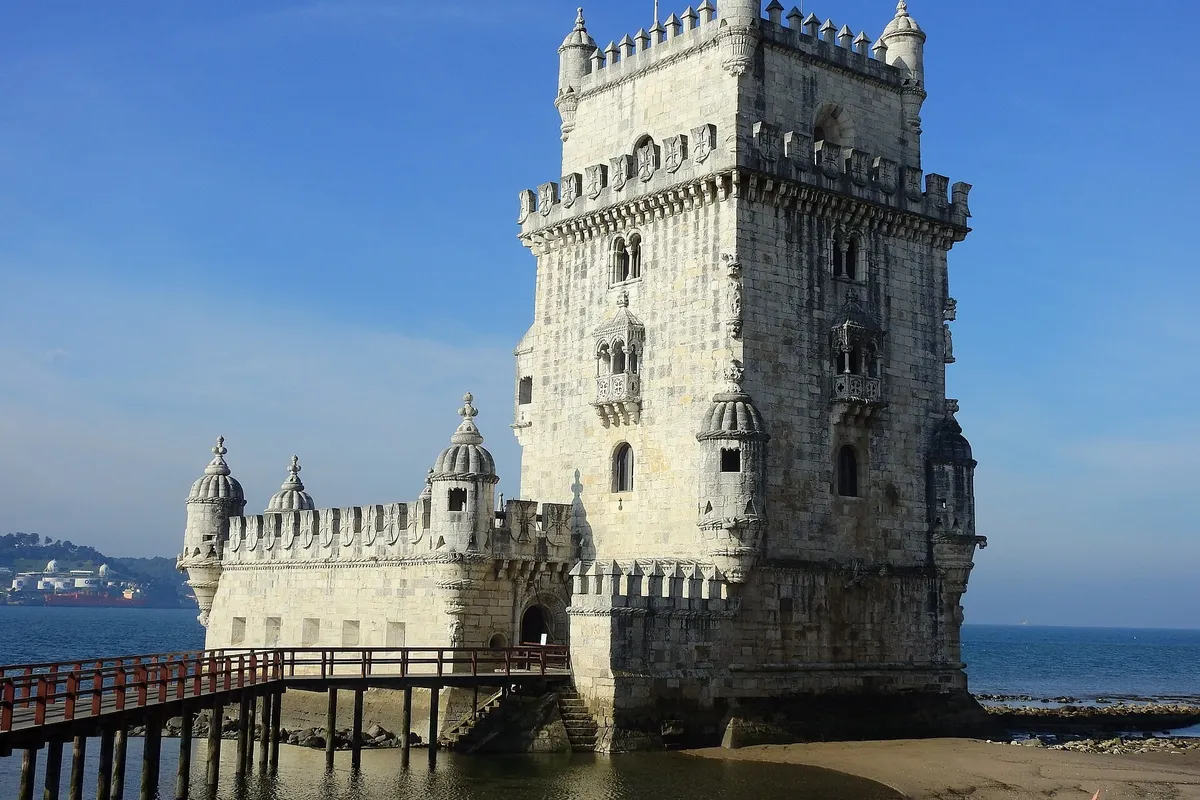
Positioned on the riverbank, the fortified Torre de Belém once guarded the entrance to Lisbon's harbor. General admission to enter the interior chambers costs €15.00 via the MMP booking system. However, the tower's interior layout relies on a single narrow spiral staircase linking all five levels. Movement is managed by an automated traffic-light system alternating every three minutes, which frequently causes 20- to 30-minute bottlenecks inside the damp stone corridors.
For many travelers, admiring the carved battlements, stone rhinoceros gargoyles, and maritime crests from the surrounding public waterfront park provides a far better experience than waiting on the internal stairs. A short walk east stands the Padrão dos Descobrimentos (Monument to the Discoveries), an imposing concrete monument shaped like the prow of a caravel. For comprehensive transit routing and detailed historical walking paths along this waterfront, read our specialized Belém guide: monuments, riverside walks and practical planning.
To reach Belém from central Lisbon, you have two primary public transit options:
- Carris Tram 15E: Departs from Praça da Figueira and Praça do Comércio, taking roughly 30 to 40 minutes depending on road traffic along Avenida 24 de Julho.
- CP Suburban Train: Departs from Cais do Sodré railway station toward Cascais, stopping at Belém station in just 7 minutes. Trains run every 20 minutes and accept the standard transit card.
Pastéis de Belém and Navigating Waterfront Crowds
Directly along the main street of Belém sits the Antiga Confeitaria de Belém, which has been baking the original monastic recipe for pastéis de nata since 1837. Arriving here in the afternoon usually means encountering a chaotic crowd blocking the sidewalk outside the storefront windows.
You do not need to stand in that exterior takeaway line. The bakery features a massive interior with interconnected dining rooms accommodating over 400 seated guests. If you walk past the counter directly into the back rooms, you can almost always find an open table within five minutes. Professional servers deliver warm pastries dusted with powdered sugar and cinnamon directly to your table with minimal delay.
If you prefer an artisan alternative closer to the city center, Manteigaria (with branches in Chiado and near the Belém waterfront) bakes batches continuously throughout the day. They ring a brass bell whenever fresh, piping-hot custard tarts come out of the ovens.
Beyond the Medieval Center: Modern Waterfront and Contemporary Dining
Lisbon is not merely an open-air museum of stone ruins and tiled alleys. Expanding your route beyond the traditional quarters reveals striking modern engineering and Portugal’s evolving culinary landscape.
Oceanário de Lisboa and the Futuristic Parque das Nações
Constructed as the centerpiece for the Expo '98 World Fair, Parque das Nações runs along the northeastern riverfront, showcasing contemporary architecture, wide waterfront promenades, and the striking Oriente Station designed by Santiago Calatrava. Its main draw is the Oceanário de Lisboa, consistently recognized as one of the finest public aquariums in the world.
According to the official ticketing portal, standard adult admission (ages 13–64) costs €25.00, while children aged 3 to 12 and seniors 65 and over pay €15.00. The central tank holds 5 million liters of saltwater, housing sunfish, manta rays, and pelagic sharks, flanked by four peripheral marine habitats recreating the Antarctic coastline, the Pacific kelp forests, the Indian coral reefs, and the Atlantic shoreline.
The Oceanário remains open 365 days a year without a Monday closure, making it an exceptional option to reserve for the start of the week when Belém’s historical venues are shut.
Time Out Market (Mercado da Ribeira) and Nightlife in Bairro Alto
Situated directly across from the Cais do Sodré rail terminus, the historic Mercado da Ribeira splits into two worlds: a traditional morning produce market on one side, and the high-energy Time Out Market food hall on the other. The hall houses curated food stalls operated by acclaimed Portuguese chefs, including Michelin-starred talent Henrique Sá Pessoa and traditional culinary master Miguel Castro e Silva.
Dining here is a distinct experience that requires realistic expectations. Main dishes from chef stalls generally range between €15.00 and €22.00, and you must hunt for your own open seat along crowded communal wooden benches during peak meal hours. By comparison, a neighborhood tasca in nearby Baixa or Alfama serves a sit-down daily lunch special (prato do dia) with bread, wine, and coffee for €8.00 to €12.00. Time Out Market is ideal for tasting high-concept dishes in small portions, but less suited for a quiet, budget-conscious meal.
From Cais do Sodré, a ten-minute walk up the steep hillside leads into Bairro Alto. By day, this residential quarter of laundry-strung balconies feels quiet and deserted. After 22:00, the metal shutters roll up to reveal hundreds of small bars. Patrons socialize directly on the narrow cobblestone lanes with plastic cups in hand, creating an energetic street-party atmosphere that lasts until late into the night.
Transit, Ticketing, and Day Trips: What to See on Your First Visit Without Overpaying
Navigating Lisbon’s hills on foot is demanding, and public transport is essential. Understanding ticketing systems upfront will save you money and prevent heavy municipal fines.
Navigating Transit: Navegante, Zapping Credit, and Inspection Penalties
Lisbon’s public transit network operates under the Navegante ticketing card system. You must purchase a reusable paper smartcard for a one-time fee of €0.50 at any metro station machine. Crucially, each traveler must hold their own individual card; you cannot tap two passengers through a gate using one card.
| Transit Option | Fare Cost | Validity & Usage Rules |
|---|---|---|
| Single Metro/Carris Advance | €1.90 | Valid for 60 minutes across metro and buses after first validation |
| Zapping Pay-as-You-Go | €1.72 | Pre-loaded credit; valid across Metro, Carris, CP trains, and ferries |
| On-board Tram Cash Fare | €3.30 | Purchased directly from driver; exact change required under €10 |
| 24-Hour Network Pass | €7.25 | Unlimited rides on Metro, Carris buses, historic trams, and elevators |
To see how transit links work right after touching down, check our guide on Lisbon Airport to the city: choosing your transfer to select the right metro or rail option immediately upon arrival.
According to Carris official penalty regulations and Portuguese Law n.º 28/2006, traveling without a ticket or failing to validate your Navegante card upon boarding is classified as a serious infraction, carrying a fine between €120.00 and €350.00. Settling the fine voluntarily within 15 business days grants a 50% discount on the minimum threshold (€60.00).
Lisboa Card Breakdown: Costs, Value Math, and Mandatory Reservations
The official Lisboa Card combines unlimited public transit with free entry to dozens of museums. An adult pass costs €31.00 for 24 hours, €51.00 for 48 hours, and €62.00 for 72 hours. While marketed as an indispensable purchase, whether it saves you money depends strictly on which day you activate it.
Where the card provides strong value: If you spend an intensive day in Belém, the card delivers immediate savings. Combining the Jerónimos Monastery (€18.00), the Belém Tower (€15.00), and the 24-hour transit network value (€7.25) totals €40.25 in standalone expenses, easily exceeding the €31.00 single-day cost.
Where the card loses money: If you spend your day exploring the historic core, the card rarely breaks even. The Sé Cathedral offers only a €2.00 discount (paying €5.00 instead of €7.00), the Carmo ruins discount just €2.00 (paying €5.00 instead of €7.00), and Castelo de São Jorge does not accept the card for free entry. Always map your sightseeing clusters before purchasing multi-day passes.
Day Trip Logistics: Rossio Train Station to Sintra
Sintra, with its forested hills and romanticist palaces, is the quintessential first-timer day trip from Lisbon. Suburban trains operated by CP depart directly from the ornate neo-Manueline Rossio Station in downtown Lisbon every 20 to 30 minutes. The journey takes 40 minutes, costing €2.40 each way, and is covered entirely by the Lisboa Card.
Once you arrive at Sintra station, transit logistics require careful coordination:
- Scotturb Bus 434: Operates a steep one-way circular loop from the train station up to the Moorish Castle and Pena Palace (Palácio Nacional da Pena). A daily hop-on hop-off ticket costs €13.50.
- Quinta da Regaleira Warning: Bus 434 does not stop at Quinta da Regaleira. To reach Regaleira's famous initiation well and gardens, take Scotturb Bus 435 from the station or walk 15 to 20 minutes directly from Sintra’s historical village center.
- Departure Advice: Board the train at Rossio before 08:30. Arriving in Sintra after 10:00 puts you directly behind tour bus convoys, leading to heavy traffic jams on the narrow mountain roads.
Strategic Planning: First-Timer Itinerary Architecture and Verdict
Structuring your daily routes requires balancing opening schedules, elevation gain, and local municipal regulations to avoid burning out early in your trip.
The Monday Rule and Monument Timing Strategy
A frequent error among first-time visitors is leaving Belém for a Monday. In Lisbon, state-run monuments managed by Museus e Monumentos de Portugal—including the Jerónimos Monastery, Belém Tower, and the National Coach Museum—are closed every Monday. Attempting to visit Belém on this day leaves you looking at locked iron gates from the street.
Conversely, plan your Monday around independent attractions and public spaces that operate seven days a week: Castelo de São Jorge, the Oceanário de Lisboa, the Sé Cathedral, and the hilltop miradouros. Furthermore, check the official MMP website ahead of your dates; several state galleries are undergoing phased restoration projects funded by the European Recovery and Resilience Plan (PRR), which can occasionally close specific wings or display halls without long warning.
Practical Budgeting: Municipal Taxes, Footwear, and Cultural Policies
Every traveler staying in tourist accommodation must factor in the municipal lodging tax. Under the Câmara Municipal de Lisboa Taxa Turística, all overnight guests aged 13 and older must pay €4.00 per person, per night. This fee is capped at a maximum of seven consecutive nights (€28.00 per person) and is collected separately by your hotel or vacation rental host upon check-in, usually in cash or via local card terminal.
Navigating Lisbon’s streets safely also requires the right footwear. The city’s pavements are paved almost entirely in calçada portuguesa—small squares of hand-cut limestone and basalt. Over decades of foot traffic, this stone polishes down to an extremely slick surface, resembling polished marble. On steep descents through Alfama or Bairro Alto, smooth-soled shoes or heels offer zero grip, especially if morning humidity or light rain coats the stone. Pack sturdy walking shoes with grooved rubber soles.
For a realistic timeline showing how to balance these sight clusters smoothly, see our recommended three days in Lisbon: a realistic first-trip itinerary.
First-Timer Route Optimization Checklist
To pull all these moving parts together into a coherent trip, follow this operational checklist when organizing your days:
- Cluster by Elevation: Dedicate one distinct day to the historic core (Baixa, Chiado, Alfama) and another full day to the western waterfront (Belém), rather than shuttling back and forth across the city.
- Secure Morning Monastic Slots: Reserve your Jerónimos Monastery cloister timed slot for the 09:30 or 10:00 window weeks in advance, and verify whether your chosen day falls on a Monday shutdown.
- Ride Trams Tactically: Treat Tram 28 as early-morning transport before 08:30 rather than an afternoon tour bus, or switch to the less crowded Tram 12E for a similar historical ride.
- Bypass Elevador Queues: Never wait an hour at the street-level base of the Santa Justa Lift; walk up through Chiado to Largo do Carmo to reach the observation terrace in five minutes.
- Carry Backup Coins: Keep small euro coins handy for quick bica (espresso) stops, bakery counters, and transit ticket validation machines that reject large bank cards.