
Planning an itinerary around Portugal sightseeing highlights requires strict attention to logistical constraints, timed-entry windows, and transit connections. After living in Lisbon for over seven years, I have seen visitors lose hours waiting in unreserved queues in Belém or get turned away at palace gates in the Serra de Sintra because their arrival missed a rigid 30-minute entry window. Public transit connections, ticket bundles, and municipal elevator networks can either streamline your trip or drain your budget if managed without verified data.
Navigating the best attractions in Portugal comes down to choosing between standalone tickets and passes, understanding seasonal operating schedules, and recognizing strict visitor quotas. State-run sites have moved toward digital capacity caps, and walking distances between hilltops can disrupt rushed schedules. Below, I evaluate the essential landmarks across Lisbon and Sintra using fixed admission rates, transit transit costs, and field observations.
Portugal Sightseeing Highlights: How We Evaluated Top Attractions
Evaluation Criteria, Pricing Transparency, and Logistical Benchmarks
To rank each site objectively, I evaluated four logistical benchmarks: crowd management protocols, transit accessibility, preservation condition, and ticketing transparency. Monuments in Lisbon and Sintra face immense foot traffic, meaning visitor caps and booking grace periods directly dictate the quality of a visit. I prioritized sites that clearly disclose capacity rules and operate direct public transit connections over attractions that rely on private shuttles.
Ticketing pricing transparency has shifted across Portugal. Parques de Sintra no longer offers a 15% discount for buying tickets online in advance; official web shop rates and physical gate prices are identical across all Sintra monuments. However, dated tickets bought through the official Parques de Sintra ticket portal allow free online rescheduling until 18:00 on the day prior to entry, valid within a 12-month window.
International visitors must also note official subsidy rules. Under the Portuguese 'Acesso 52' scheme managed by Museus e Monumentos de Portugal, free entry on 52 designated days each year applies exclusively to Portuguese citizens and legal tax residents. Foreign visitors must purchase standard admission tickets every day of the week, regardless of public holidays or Sundays.
Avoid booking third-party reseller tickets that do not assign a precise timed-entry slot. State monuments refuse entry if your ticket lacks an official digital time stamp.
How I Compared Independent Admissions Against Passes and Combined Logistics
Deciding between standalone tickets and integrated city passes requires clear math. The official 24-hour Lisboa Card costs €31.00, while the 48-hour card costs €51.00 and the 72-hour pass costs €62.00. Visiting the cloisters at Jerónimos Monastery (€18.00) and Belém Tower (€15.00), combined with three metro or tram journeys (€5.40 minimum on single fares), totals €38.40 in standalone value. In this scenario, the 24-hour pass yields €7.40 in direct savings alongside unlimited rides on Carris transit, the metro network, and the Santa Justa Lift.
However, the Lisboa Card loses its cost-efficiency on day trips outside central Lisbon. While it covers suburban CP trains from Rossio Station to Sintra, it does not include the €20.00 Essential Visit ticket to the interior staterooms of Pena Palace or the €20.00 entrance to Quinta da Regaleira. For visitors traveling to Sintra, paying single transit fares of €2.40 each way using a reloadable Navegante Occasional card (€0.50 initial card purchase) alongside individual monument tickets is significantly cheaper than consuming days on a multi-day pass.
Interactive Directory Controls: Filter the comparative registry below by region (Lisbon / Sintra), landmark category (Castle, Monastery, Palace, Estate, Museum, Transit Pass), or entry fee tier (Under €10, €10–€20, Over €20). The table can be sorted dynamically by lowest starting price or site name.
| Landmark / Pass | Location | Category | Price From | Primary Advantage | Key Limitation |
|---|---|---|---|---|---|
| Castelo de São Jorge | Lisbon | Castle | €17.00 | Intact 11th-century battlements, expansive Tagus River views, and 90-day ticket validity | Steep uphill climb on foot; Camera Obscura runs on weather-dependent seasonal sessions |
| Jerónimos Monastery | Lisbon | Monastery | €18.00 | Premier Manueline cloisters; free entry to Santa Maria de Belém nave | Lisboa Card holders must pre-book a zero-value timed slot; cloister line strictly enforced |
| Belém Tower | Lisbon | Historic tower | €15.00 | 16th-century riverfront defensive fortress and stone-carved artillery bastion | Capped at 60 simultaneous visitors (~900/day); interior spiral staircase controlled by traffic lights |
| Oceanário de Lisboa | Lisbon | Aquarium | €25.00 | 5-million-liter central ocean basin with four distinct coastal marine habitats | Higher admission cost; dynamic pricing rises to €29.00 during peak morning slots |
| Quinta da Regaleira | Sintra | Historic estate | €20.00 | 27-meter spiral subterranean Initiation Well and landscaped mystical grottos | Concessions rose to €15.00; significant bottlenecks form at the Initiation Well stairs |
| Park and National Palace of Pena | Sintra | Palace & park | €12.00 | Exterior palace terraces, Chalet of Countess of Edla, and 85-hectare exotic park | Strict 30-min interior slot forfeit rule; steep climb from main gate or €4.50 shuttle fee |
| Carmo Archaeological Museum | Lisbon | Gothic ruins & museum | €7.00 | Roofless Gothic nave from 1755 earthquake; easy flat access from Chiado | Compact exhibition area (~45-min dwell time); no shelter over open-air nave during rain |
| Lisboa Card | Lisbon | Sightseeing pass | €31.00 | Free transit on Metro, Carris, CP trains, plus entry to 51 state monuments | Requires zero-value timed reservations for Belém; does not include Pena interior or Regaleira |
| Yellow Bus Tours Lisbon | Lisbon | Sightseeing tour | €28.00 | 48-hour access to Belém and Modern Lisbon lines with multilingual audio guides | Does not include monument admissions; open-top buses face central traffic delays |
Historic Places in Portugal: Lisbon’s Castles, Ruins, and Riverfront Heights
Castelo de São Jorge: Conquering the Hilltop Fortification and Alfama Overlooks
Dominating Lisbon's historic skyline, Castelo de São Jorge preserves 11th-century Moorish battlements, defensive towers, and shady pine courtyards inhabited by free-roaming peacocks. The fortified stone perimeter looks directly over the red tile roofs of Alfama down to the Tagus River estuary. Walking the elevated stone walkways offers unmatched vantage points of central Lisbon, though visitors must navigate uneven cobblestones and steep steps without modern handrails.
Standard adult entry costs €17.00, while visitors aged 13–25 pay €8.50, seniors aged 65 and over pay €14.00, and children aged 12 and under enter free. Tickets must be booked via Castelo de São Jorge BOL ticketing, which serves as the official platform. Tickets purchased through BOL remain valid for entry within 90 days from the selected date, providing schedule flexibility if rain sets in.
Inside the Torre de Ulisses, the castle operates a periscope Camera Obscura projecting real-time optical views of the city. Access is included with castle admission via guided tours, but operates on four strict seasonal windows: 11:00–13:00 (October–February), 11:00–14:00 (March), 11:00–15:00 (April and September), and 11:00–16:00 (May–August). Sessions require clear weather and same-day registration at the ticket office.
Skip the overcrowded Tram 28E line. Take the free public Elevador do Castelo inside the building at Rua dos Fanqueiros 170–178 up to Rua da Madalena, walk 30 meters to the Chão do Loureiro supermarket elevator, and ride to Costa do Castelo to eliminate 80% of the uphill walk.
Carmo Archaeological Museum: Surviving the 1755 Great Earthquake
Standing above Chiado on Largo do Carmo, the Carmo Archaeological Museum presents one of the most distinctive historic places in Portugal. Founded in 1389 as a Carmelite convent, its Gothic church collapsed during the devastating earthquake and subsequent fires of November 1, 1755. Rather than rebuilding the roof, the city preserved the skeletal arches pointing open to the sky as a permanent monument to the catastrophe.
The roofless nave leads into the enclosed chancel and apse rooms, which house an eclectic archaeological collection assembled by the Association of Portuguese Archaeologists. Prominent displays include the 14th-century Gothic tomb of King Ferdinand I (D. Fernando I), carved Roman funerary steles, Visigothic architectural fragments, and two naturally mummified Peruvian bodies from the pre-Columbian era. Standard adult admission is €7.00, discounted to €5.00 for Lisboa Card holders, students, and seniors aged 65 and over, while children aged 14 and under enter free.
Most visitors spend 45 to 60 minutes exploring the ruins. You can access the museum directly on level ground by walking across the Carmo terrace from Chiado via Travessa do Carmo. This approach also allows you to walk directly onto the upper viewing platform of the Elevador de Santa Justa without paying the steep €6.00 round-trip lift fare or standing in the hour-long line on Rua do Ouro below.
The Manueline Landmarks of Belém: Defensive Fortresses and Monastic Cloisters
Jerónimos Monastery: Maritime Discoveries and the World-Famous Cloisters
Commissioned by King Manuel I in 1501 to celebrate Vasco da Gama's maritime route to India, Jerónimos Monastery represents the pinnacle of Portuguese late Gothic Manueline architecture. The limestone limestone facade stretches over 300 meters along the Belém riverfront. The monument is designated as a UNESCO World Heritage Site, celebrated for its two-tier cloisters sculpted with nautical motifs, armillary spheres, twisted ropes, and indigenous flora discovered during the Age of Exploration.
General admission to the cloisters costs €18.00 for adults, with a 50% concession (€9.00) for youths aged 13–24 and seniors aged 65 and over; children aged 12 and under enter free. In contrast, entering the adjoining Church of Santa Maria de Belém is completely free of charge. Inside the lower choir of the church stand the stone-carved tombs of navigator Vasco da Gama and poet Luís de Camões, supported by sculpted marble lions.
The cloister and the church operate separate entrance lines. Cloister capacity is strictly monitored via digital gates. If you hold a Lisboa Card, you cannot join the drop-in line; you must reserve an online zero-value timed-entry ticket in advance through the official ticketing system to guarantee entry.
Always clear the cloister security checkpoint first if your timed slot is within 20 minutes. Visiting the free church first can cause you to miss your cloister entry window, which invalidates your paid booking.
Belém Tower: Capacity Limits, Tides, and Architectural Symbolism
Constructed between 1514 and 1519 on a basalt outcrop in the Tagus River, Belém Tower originally served as a fortified water gate and artillery platform defending Lisbon's harbor. Its architecture blends Manueline masonry with Moorish-style ribbed watchtower domes and stone battlements bearing the Cross of the Order of Christ. A timber gangway connects the riverbank to the stone artillery bastion, which originally housed 17 cannons aimed across the estuary.
Following extensive conservation work, the monument operates under updated capacity limits. The interior allows a maximum of 60 visitors at any single time, capped at approximately 900 admissions per day in staggered 30-minute intervals. Admission costs €15.00 for adults, while children aged 12 and under enter free. Lisboa Card pass holders enter free but must pre-book a zero-value timed ticket online due to the strict daily threshold.
Movement between the bastion, the governor's quarters, and the upper terrace relies on a single narrow spiral staircase. Interior traffic is managed by automated red and green indicator lights that alternate passenger flow between floors. For travelers with severe mobility challenges or claustrophobia, navigating the staircase can be demanding; viewing the exterior carvings and the sculpted rhinoceros head bracket from the waterfront walkway may prove more comfortable.
Sintra Day Trip from Lisbon: Romanticism, Palaces, and Mystic Estates
Park and National Palace of Pena: Navigating Timed Entries and Crown Grounds
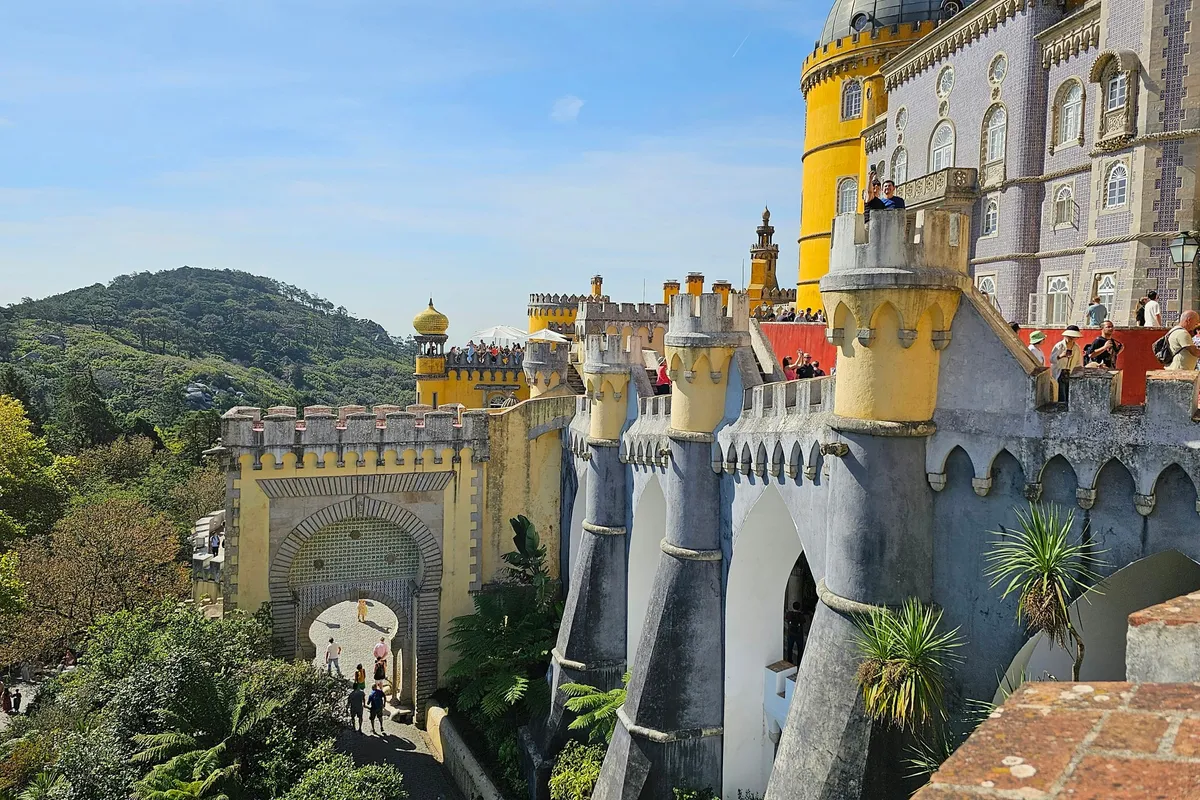
Set across the peaks of the Serra de Sintra, the Park and National Palace of Pena stands as the centerpiece of Sintra's cultural landscape. Created in the 19th century by King Consort Ferdinand II, the palace combines vibrant yellow and red Romanticist revivalism, Moorish arches, Gothic towers, and neo-Manueline carvings around the ruins of a 16th-century monastery. On clear days, the palace terraces look out across the coastline to the Atlantic Ocean and the Tagus River.
Ticketing options require careful selection. The Essential Visit ticket costs €20.00 for adults (ages 18–64) and €18.00 for youths (6–17) and seniors (65+), granting access to the interior staterooms, exterior terraces, and the surrounding 85-hectare grounds. A Park-only ticket costs €12.00 for adults and €10.00 for youths and seniors, giving access to the palace terraces, the Chalet of the Countess of Edla, and the forest trails, but excluding the interior royal bedrooms and dining rooms. Children aged 0–5 enter free under both tiers but require a pre-booked zero-value ticket.
The interior palace rooms enforce a rigid 30-minute timed-entry slot. If you arrive at the interior turnstile even 5 minutes after your slot expires, staff will deny access to the staterooms without offering a refund. Reaching the palace from Sintra train station requires either taking Scotturb bus 434 or climbing steep mountain trails. Once past the main entrance gate, reaching the palace entrance involves a steep 20- to 30-minute walk through the grounds, or purchasing an internal shuttle transfer ticket for €4.50 round-trip.
Catch the direct CP urban train from Lisbon Rossio Station to Sintra. The journey takes 40 minutes and costs €2.40 each way on a Navegante card. I recommend boarding trains departing before 08:30 to reach Sintra ahead of tour buses.
Quinta da Regaleira: Subterranean Tunnels and the Initiation Well
Located on the lower slopes near the historic center of Sintra, Quinta da Regaleira presents an estate built between 1904 and 1910 by wealthy entomologist António Augusto Carvalho Monteiro and Italian architect Luigi Manini. The property includes a gothic-revival palace, a stone chapel, and landscaped gardens featuring concealed tunnels, grottoes, and mythological statues reflecting Masonic and Templar symbolism.
The primary architectural landmark within the gardens is the Initiation Well (Poço Iniciático), a 27-meter subterranean stone gallery dropping through nine spiraling tiers supported by carved arches. At the base of the well, visitors navigate dark underground passages that exit across stepping stones resting on a green lake. Standard adult tickets cost €20.00, while tickets for youths (6–17) and seniors (65+) cost €15.00 via Regaleira Blueticket booking. Entry operates in mandatory 30-minute timed slots with a maximum 60-minute arrival grace period.
During peak midday hours, queues to enter the narrow staircase of the Initiation Well can back up for 30 to 45 minutes along the woodland path. To avoid delays, book the first morning slot at 09:30 and head straight up the hill to the well before exploring the chapel or the main palace building. The estate sits roughly 800 to 900 meters (a 10- to 15-minute gentle walk) from Sintra's historic town center along Rua Barbosa do Bocage, or a 25-minute walk from the CP train station, meaning you do not need to pay for local tourist buses to reach the gates.
Modern Lisbon and Sightseeing Tours: Urban Transit, Ocean Life, and City Passes
Oceanário de Lisboa: Marine Architecture at Parque das Nações
Constructed inside the former Expo '98 grounds along the eastern waterfront, Oceanário de Lisboa stands as one of the world's most acclaimed aquariums. Designed by architect Peter Chermayeff, the main pavilion appears to float over the waters of a dock in the Tagus River. The building is organized around a 5-million-liter central ocean tank housing pelagic fish, sandbar sharks, manta rays, and large sunfish (Mola mola).
Four surrounding marine enclosures replicate distinct global coastal habitats: the rocky North Atlantic coast, the Antarctic ice coastline with Magellanic and gentoo penguins, the temperate Pacific kelp forests featuring sea otters, and the tropical Indian Ocean coral reefs. Viewing windows are arranged so that the central pelagic tank remains visible across the corners of each coastal display, giving visitors the illusion of a single continuous ocean.
Admission runs on a dynamic pricing schedule for visitors aged 13–64: €29.00 for morning slots (10:00–11:30), €27.00 for midday slots (12:00–15:30), and €25.00 for late afternoon visits (16:00–18:30). Booking after 16:00 cuts €4.00 off standard admission fees and avoids school group congestion. Reaching the aquarium is straightforward: take the Lisbon Metro Red Line to Oriente Station, followed by an 8-minute flat walk through the riverfront gardens.
Lisboa Card vs. Yellow Bus Tours: Comparing Transit and Sightseeing Coverage
Travelers exploring Lisbon often debate whether to use city passes or commercial sightseeing buses. The Lisboa Card functions as a comprehensive municipal transit and museum pass, providing free travel on the metro, Carris buses, historical trams, the Santa Justa Lift, and CP suburban rail lines to Sintra and Cascais. It includes free access to 51 monuments, including the Jerónimos Monastery cloisters, Belém Tower, and the National Tile Museum.
By contrast, Yellow Bus Tours Lisbon offers a 48-hour combo ticket priced at €28.00 for adults (ages 17+), €21.00 for youths (11–16), and €14.00 for children (4–10). This ticket covers two open-top routes: the Belém Lisbon Bus Tour and the Modern Lisbon Bus Tour. However, Yellow Bus passes provide transit and audio commentary only; they do not include entry tickets to any museums, castles, or historic monasteries.
The choice comes down to personal walking tolerance. Active travelers who plan to explore monument interiors and ride urban transit save money with the Lisboa Card. However, travelers with limited physical mobility who want an elevated, open-top audio tour without walking steep hills will find the 48-hour Yellow Bus ticket a more practical transit option, though riverfront traffic along Avenida da Índia can cause delays during afternoon commute hours.
Transit and Attraction Cost Calculator
Estimate your combined transit and entrance expenses for a typical day in Lisbon or Sintra based on official 2026 pricing:
- Central Lisbon Historic Day: Castelo de São Jorge (€17.00) + Carmo Archaeological Museum (€7.00) + 3 Metro/Carris single fares (€5.40) = €29.40 per adult.
- Belém Monument Circuit: Jerónimos Monastery (€18.00) + Belém Tower (€15.00) + Tram 15E round-trip (€3.60 on Navegante) = €36.60 per adult (A 24-hour Lisboa Card costs €31.00, saving €5.60).
- Sintra Royal Day Trip: CP Train round-trip from Rossio (€4.80) + Pena Palace Essential Visit (€20.00) + Quinta da Regaleira (€20.00) = €44.80 per adult.
Strategic Verdict: Best Portugal Attractions by Travel Scenario
Recommended 1-Day, 2-Day, and 3-Day Itineraries
Structuring your route around geographic clusters prevents wasted transit hours. For a 1-day central Lisbon tour, begin at 09:00 at Castelo de São Jorge using the Fanqueiros elevator to avoid morning crowds. Walk down through the Alfama alleyways toward Baixa, continue to the Carmo Archaeological Museum by 11:30 via Largo do Carmo, and board Tram 15E to Belém by 14:00 to visit Jerónimos Monastery and the exterior of Belém Tower using pre-booked time slots.
For a 2-day itinerary, focus Day 1 entirely on Lisbon's historic center and the Belém riverfront. Dedicate Day 2 to a day trip to Sintra. Take the 08:11 or 08:41 CP train from Rossio Station directly to Sintra. Walk 15 minutes to Quinta da Regaleira for a reserved 09:30 or 10:00 morning entry slot. By 13:30, catch bus 434 or hike up to the Park of Pena, utilizing a 14:00 Park-only ticket (€12.00) to explore the terraces, gardens, and the Countess of Edla Chalet without waiting in the congested interior line.
A 3-day itinerary adds modern architectural highlights and local dining districts. Spend the morning of Day 3 visiting Oceanário de Lisboa at Parque das Nações, walking along the riverside park to admire the contemporary Calatrava-designed Gare do Oriente. Conclude the final evening with dinner at a traditional fado house in Alfama or Mouraria, reserving a table along Rua dos Remédios to experience traditional music within Lisbon's oldest surviving quarter.
Verdict by Traveler Profile: Families, History Enthusiasts, and Budget Travelers
Families with young children should prioritize Oceanário de Lisboa for its spacious ramps, stroller accessibility, and engaging marine tanks. When visiting Sintra with young children, choose the Pena Palace Park-only ticket (€12.00 adult; free for ages 0–5) rather than the interior palace stateroom tour. Navigating narrow interior palace hallways with strollers is challenging, and the €4.50 internal park shuttle saves children from a steep 30-minute uphill trek.
History and architecture enthusiasts will gain the most value from the Manueline masonry at Jerónimos Monastery (€18.00) and the open-air Carmo Convent nave (€7.00). Ensure your Belém Tower zero-value slot is booked days in advance through the official portal to secure access under the 60-person simultaneous capacity limit.
Budget-conscious independent travelers should rely on the reusable Navegante card (€0.50 card plus €2.40 single train fares to Sintra) instead of private tours or commercial hop-on hop-off buses. Opting for Pena Park-only access saves €8.00 per adult over the Essential Visit, while the Church of Santa Maria de Belém at Jerónimos Monastery offers access to the tombs of historic figures completely free of charge.