
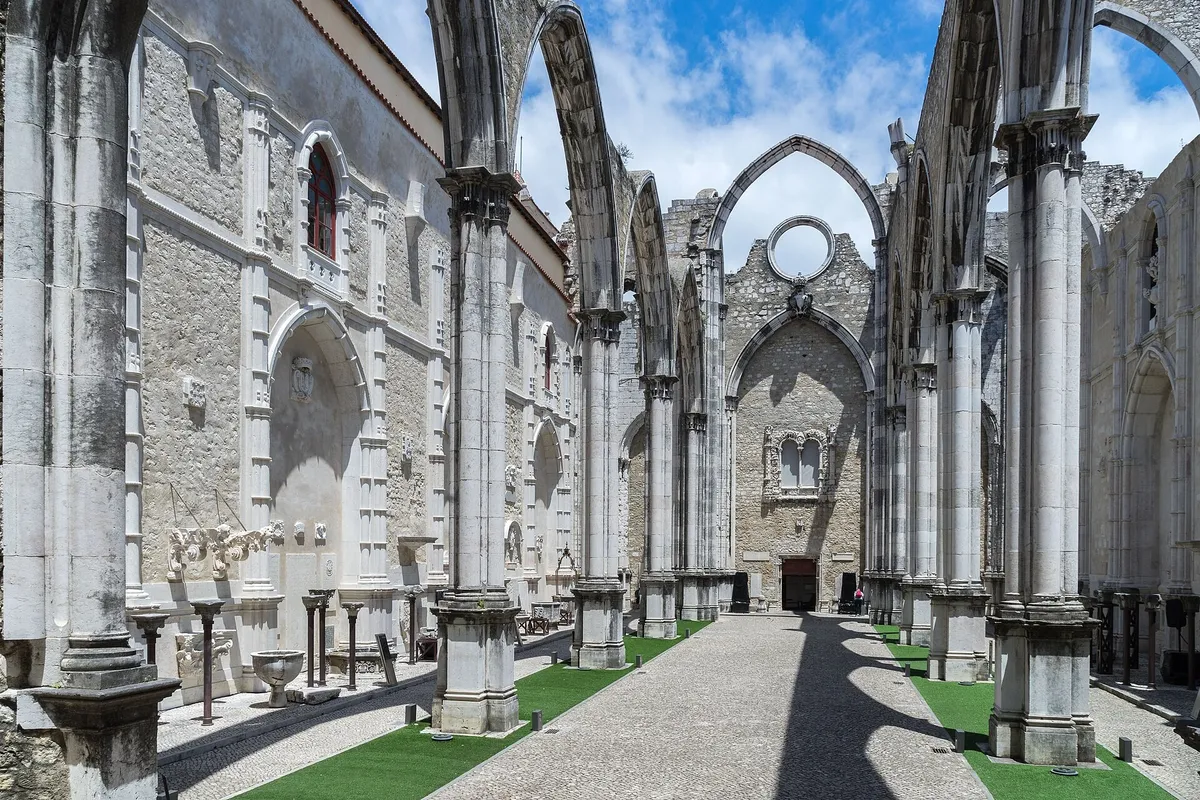
A visit to the Carmo Archaeological Museum (*Museu Arqueológico do Carmo*) takes you straight inside the skeletal stone frame of what was once Lisbon's grandest medieval church. Rising directly above the historic center, the roofless nave and Gothic arches open sky create a stark, open-air memorial to the 1755 Lisbon earthquake, housing centuries of Portuguese epigraphy, royal tombs, and oddities in its preserved chancel chapels.
During my walks across Chiado, I often see travelers waiting in long, unnecessary lines or arriving on Sundays when the complex is shut. This practical guide breaks down everything you need to plan your visit: exact transit routes, ticketing rules, seasonal operating hours, crowd patterns, and what the exhibits actually contain.
Location and Directions: Reaching Convento do Carmo in Lisbon
Address, Public Transit Links, and Street Access
The museum sits prominently in upper Chiado at Largo do Carmo, 1200-092 Lisboa. Navigating Lisbon's vertical terrain means choosing your arrival route carefully to avoid grueling uphill climbs on slick limestone sidewalks.
The most straightforward transit connection is via the Lisbon Metro. Take the Blue or Green line to Baixa-Chiado station. Take the marked Chiado/Rua Garrett exit to surface near Praça Luís de Camões. From there, walk roughly 250 meters along Rua Garrett and turn uphill on Calçada do Sacramento, which leads directly into Largo do Carmo.
If you arrive by rail on the Sintra line at Rossio Railway Station, you can reach the museum on foot in roughly 5 to 7 minutes. However, this walk involves climbing roughly 250 meters steeply uphill along the stone stairways of Calçada do Carmo. For bus and tram options, the historic Tram 28 and Carris bus 758 have stops situated a short walk away along the main streets of Chiado, as listed in the Carmo Museum Contacts Directory. For general transit tickets and navigation advice, consult our guide to getting around Lisbon.
Driving to Convento do Carmo is strongly discouraged. Largo do Carmo and the adjacent Chiado streets are designated low-emission, restricted-access pedestrian zones. There is zero on-street parking for visitors. If you drive, use commercial underground garages like Parque Camões under Praça Luís de Camões or Parque Restauradores, both a steep 5-to-10-minute walk away.
Connecting via the Santa Justa Lift Pedestrian Walkway
Many visitors mistakenly believe they must pay for and ride the famous Santa Justa Lift to access Convento do Carmo. In reality, the top platform of the elevator connects directly to the rear of the convent via an elevated pedestrian footbridge.
You can walk freely behind the ruins along Travessa Dom Pedro de Menezes to step onto the elevator terrace. As noted on the Visit Lisboa Santa Justa Lift portal, crossing this pedestrian footbridge to access Largo do Carmo or take in views over Baixa and Castelo de São Jorge is completely free. This route allows you to bypass the lengthy ground-level ticket lines and steep boarding fees down on Rua de Santa Justa.
While the connecting bridge to Largo do Carmo is free, continuing up the tight, metal spiral staircase to the elevator's highest observation deck (*miradouro*) requires a separate turnstile ticket. If your goal is simply to reach the Carmo ruins and enjoy views over Rossio, the free walkway is more than sufficient.
Carmo Convent Opening Hours, Seasonal Schedules, and Time Planning
Summer vs. Winter Operating Schedules and Closures
The site operates on distinct summer and winter schedules. The ticket desk cuts off entry strictly 20 minutes before closing time each day, and staff begin directing visitors toward the exit roughly 10 minutes prior to final shuttering.
| Period / Season | Days of Operation | Hours | Last Entry Cut-off |
|---|---|---|---|
| Summer (May 1 – Oct 31) | Monday to Saturday | 10:00 – 19:00 | 18:40 |
| Winter (Nov 1 – Apr 30) | Monday to Saturday | 10:00 – 18:00 | 17:40 |
| Easter & Festive (Dec 26 – Jan 6) | Monday to Saturday | 10:00 – 19:00 | 18:40 |
| Sundays (Year-round) | Closed | None | None |
| Annual Holidays (Jan 1, May 1, Dec 25) | Closed | None | None |
Keep the annual holiday calendar in mind: the museum is completely closed on January 1, May 1, and December 25. Most importantly, Convento do Carmo is closed every Sunday throughout the entire year. If you are structuring a weekend trip, reserve your Sunday for other monuments that remain open, such as those featured in our guide to Lisbon attractions.
How Much Time to Budget and Optimal Visiting Windows
Expect to spend between 45 and 60 minutes touring the entire site. Allocating 20 minutes allows for a thorough walk through the roofless nave and exterior lapidary displays, while 25 to 35 minutes provides ample time to inspect the royal tombs, Pre-Columbian artifacts, and epigraphic stones inside the enclosed apse chapels.
Timing your arrival makes a noticeable difference to your experience. Between 11:00 and 14:30, walking tours heavily converge on Largo do Carmo, generating queues at the small ticket booth. Midday sunlight also beats directly down into the roofless nave, washing out architectural relief carvings and creating harsh, high-contrast shadows for photography.
The ideal time to enter is at 10:00 right at opening, or during late afternoon between 17:00 and 18:00 in summer. The lower sun casts warm, angled light through the Gothic archways, and the foot traffic inside drops considerably once larger guided groups depart.
Carmo Ruins Tickets, Pricing Categories, and Booking Rules
Admission Prices, Discounts, and the Lisboa Card Rate
Tickets for the Carmo Archaeological Museum remain modest compared to many other monuments in the capital. Unlike state-run sites managed by the Directorate-General for Cultural Heritage, the convent is managed by the Association of Portuguese Archaeologists (*Associação dos Arqueólogos Portugueses*), which maintains its own independent pricing structure.
| Ticket Category | Price (EUR) | Conditions & Requirements |
|---|---|---|
| Standard Adult | €7.00 | General admission for individual visitors |
| Lisboa Card Holder | €5.00 | Valid card required; saves €2.00 on entry |
| Students | €5.00 | Must present valid student photo ID card |
| Seniors (Aged 65+) | €5.00 | Requires government-issued photo ID |
| Portuguese Residents | €5.00 | Requires official proof of residency |
| Large Groups | €5.00 per person | Applies to organized groups of over 30 people |
| Children (14 and under) | Free | Must be accompanied by a paying adult |
| Disabled Visitors (≥60%) | Free | Includes free admission for one companion |
| ICOM Members | Free | Valid professional membership card required |
A frequent point of confusion among travelers involves the city pass: holders of the official Lisboa Card do not get free admission here. Instead, you receive a €2.00 discount, bringing the entry fee down to €5.00. Official educational guided tours cost a flat €7.00 per person across standard, student, and senior tiers, but these must be booked in advance by contacting the museum's educational department directly.
Purchasing Channels, On-Site Reception, and Payment Methods
There is no online reservation system or advance time-slot booking available through the official museum website. Every visitor must purchase tickets in person at the reception counter located immediately inside the heavy wooden portal on Largo do Carmo.
The counter accepts Euro cash, standard Visa or Mastercard credit and debit cards, and the local Portuguese mobile service MB Way. Note that MB Way functions exclusively for holders of Portuguese domestic bank accounts. If you are an international traveler, carry a physical payment card with chip or tap functionality, or sufficient cash in small bills.
Tickets issued at the counter are paper slips valid strictly for immediate, same-day entry. The desk does not pre-sell admissions for subsequent days. Lisboa Card holders must also wait in the standard physical line to pay the €5.00 reduced rate, as there is no designated fast-track desk.
Architecture and Interior Exhibits of the Carmo Archaeological Museum
The Roofless Nave and 1755 Lisbon Earthquake Legacy
Founded in 1389 by Constable Nuno Álvares Pereira, Convento do Carmo was originally established as Lisbon’s premier Carmelite monastery. Its towering Gothic structure dominated the skyline of the hill facing the São Jorge Castle for nearly four centuries until disaster struck on the morning of November 1, 1755.
The Great Lisbon Earthquake shook the city to its foundations, collapsing the stone vaulted ceiling of the nave onto the congregation gathered for All Saints' Day mass. While Queen Maria I initiated reconstruction in the late 18th century, work halted permanently in 1834 when religious orders were dissolved across Portugal.
Today, the central space remains entirely open to the sky, spanned by five pointed Gothic transverse arches that have withstood centuries of weather and tremors. The perimeter aisles function as an open-air lapidary gallery, showcasing medieval stone heraldry, carved limestone capitals, and architectural spolia rescued from damaged buildings throughout the country.
In 1864, the Association of Portuguese Archaeologists turned the ruined site into Portugal's first public archaeological museum. The aim was to create a permanent repository for endangered national treasures during an era when monasteries were routinely neglected or repurposed as military barracks.
Highlights of the Enclosed Archaeological Collection
The roofed apse chapels (*Capela-Mor* and side chapels) at the eastern end of the church house the museum’s enclosed permanent collection. Here, artifacts range from prehistoric Iberian settlements to curious collections brought from overseas territories.
- Tomb of King Ferdinand I: Located in the main chancel, this 14th-century carved limestone sepulcher is one of Portugal's finest examples of Gothic funerary sculpture. The monument was transferred here from the ruined Convent of São Francisco in Santarém to ensure its preservation, as documented on the Carmo Museum Educational Service portal.
- Pre-Columbian Peruvian Mummies: Displayed inside climate-controlled glass cabinets in a side chapel, two naturally preserved Andean chullpa mummies sit bound in traditional flexed postures alongside antique textiles.
- Egyptian Funerary Artifacts: A painted wooden anthropoid sarcophagus and an intricate cartonnage mummy mask from Ptolemaic Egypt form part of the eclectic 19th-century private collections donated to the association, described in detail in the Carmo Museum Collections Register.
- Prehistoric and Roman Epigraphy: Notable displays include Chalcolithic pottery and stone tools excavated from the fortified settlement of Vila Nova de São Pedro (Azambuja, dating back to 3000 BC), alongside Roman funerary stelae recovered across Lusitania.
Practical Visitor Experience: Comfort, Rules, and Accessibility
Environmental Exposure, Ambient Noise, and Footwear
Because the central nave lacks a roof, visiting Convento do Carmo exposes you completely to the weather. On bright summer afternoons, the pale limestone floor reflects heat intensely, and shaded spots along the perimeter walls are limited. Bring sunglasses and drink water before passing through the ticket barrier.
On rainy days, water falls straight onto the nave pavement. Puddles form quickly across the stone floor, making surfaces slick and pushing visitors to crowd under the narrow perimeter eaves and inside the apse chapels. Wear sturdy, rubber-soled shoes to maintain traction on the uneven, historic stone slabs.
Ambient street noise from the bustling square outside is largely buffered by the thick perimeter masonry, giving the interior a calm, contemplative feel. For digital connectivity, the museum provides complimentary public Wi-Fi access throughout both the open nave and the enclosed exhibition galleries.
Photography Restrictions, Suitcases, and Facility Rules
Visitor regulations inside the complex are actively monitored by floor wardens, as detailed in the Carmo Museum Official Admissions Directory:
- Tripods and Flash: Flash photography is strictly forbidden everywhere. Tripods and monopods are not allowed on the premises; staff treat handheld selfie sticks as monopods, so pack them away before entering.
- Filming Permits: Video recording for commercial, academic, or professional projects requires prior written authorization from the museum board.
- Suitcase Restrictions: There are no public luggage lockers inside the museum. Large travel cases and rolling baggage are barred at the entrance; reception staff will hold small daypacks only if counter space permits. If arriving directly from transit with bulky bags, utilize the luggage lockers inside Rossio train station, 250 meters away down the stairs.
- Food, Drink, and Smoking: Consuming food, drinking (other than small personal water bottles), and smoking or vaping are prohibited in all indoor and outdoor areas of the site.
- Pets: Household pets are not permitted inside. Exceptions apply only to certified guide dogs and very small animals carried continuously in closed carriers or on laps.
Wheelchair Accessibility and Mobility Facilities
Navigating the historic site with mobility limitations requires some care, but facilities have improved in recent years. The main portal from Largo do Carmo is level, allowing manual and powered wheelchairs direct access onto the nave floor.
Moving from the central nave up into the enclosed apse chapels involves overcoming historic stone steps. Museum attendants deploy portable ramps upon request to bridge these level changes. An accessible public restroom equipped with a baby-changing station is located on the ground floor near the entrance.
Visitors presenting an official medical disability certificate showing a rating of 60% or higher receive free admission, alongside one accompanying caregiver.
Honest Downsides, Suitability, and Chiado Context
Honest Downsides and Who Should Skip the Museum
While Convento do Carmo is one of central Lisbon's most atmospheric landmarks, it is not suited to every traveler’s itinerary. Being aware of its limitations helps set realistic expectations:
- Weather Vulnerability: In driving rain, the central experience–standing beneath the soaring arches–is severely compromised, leaving you with just five small indoor chapels to explore.
- No Advance Reservations: During summer mornings, lines at the single on-site ticket window spill out into Largo do Carmo. If your schedule requires precise time-slot bookings, you may find the ticketing wait frustrating.
- Compact Museum Footprint: Travelers expecting a grand, multi-room institution like the National Archaeology Museum in Belém will find this collection small. If you are not drawn to carved architectural fragments or earthquake history, a 45-minute visit may feel brief.
- Sunday Closures: Weekend city-break visitors often reserve museum tours for Sundays. Attempting to visit then will leave you staring at locked wooden doors.
Chiado Walking Tour Integration and Ideal Visitor Profile
The Carmo Archaeological Museum is best experienced as part of an unhurried walking tour through Chiado and the upper city. Its position makes it easy to combine with nearby viewpoints, historic cafes, and literary landmarks.
- Praça Luís de Camões: Begin your walk in the heart of Chiado, stopping for an espresso at the landmark Café A Brasileira on Rua Garrett.
- Livraria Bertrand: Walk a few paces along Rua Garrett to visit the world's oldest continuously operating bookstore, founded in 1732, as recognized by the Visit Lisboa Bertrand Directory.
- Largo do Carmo: Head up Calçada do Sacramento to the peaceful square in front of the convent. In May and June, the square fills with blooming purple jacaranda trees surrounding the 18th-century Chafariz do Carmo fountain.
- Convento do Carmo Ruins: Tour the museum and nave for 50 minutes.
- Santa Justa Terrace: Exit and loop around the rear of the convent along Travessa Dom Pedro de Menezes to step onto the upper pedestrian bridge of the Santa Justa Lift for views across Baixa.
- Rossio Descent: Finish by taking the stone steps of Calçada do Carmo down into Rossio Square.
Final Assessment
At €7.00 for standard admission (and €5.00 with the Lisboa Card), Convento do Carmo offers exceptional value. It remains one of the few places in Lisbon where the physical devastation of the 1755 earthquake can be appreciated in raw masonry and open sky rather than on a museum plaque. If you schedule your visit for a dry morning right at 10:00 or late on an afternoon between Monday and Saturday, it easily ranks among the most memorable hours you will spend in the city center.