
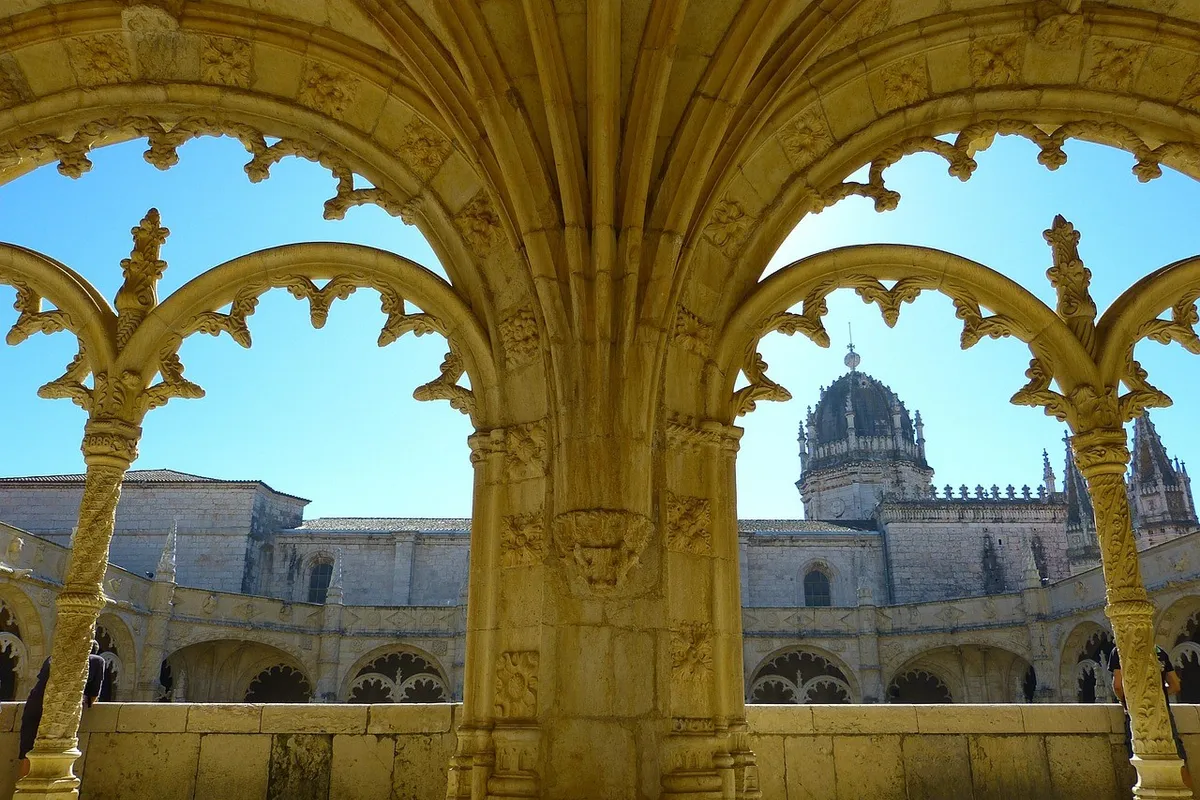
Standing in the morning shadow of Praça do Império, the sheer scale of the limestone facade makes it obvious why Jerónimos Monastery Lisbon draws thousands of daily visitors. Commissioned at the dawn of the sixteenth century, this complex served as the spiritual sanctuary for mariners departing along the Tagus River. Today, organizing a smooth visit requires concrete logistics: cloister admissions now operate on strictly timed digital entry slots, the adjacent church remains entirely free to enter, and arriving without a pre-purchased barcode frequently means standing for up to two hours under the open sun on the western pavement.
Over the seven years I have lived in Lisbon, I have walked past the monastery gates in Belém dozens of times, watching independent travelers get turned away because they confused the free church queue with the cloister entrance or arrived with oversized luggage that staff cannot store. In this guide, I have assembled the exact ticketing regulations, schedule limitations, architectural routes, and transit connections you need to navigate the site efficiently and avoid the most common operational bottlenecks.
Jerónimos Monastery Lisbon: Essential Overview and Practical Planning
Historical Monument Profile, Manueline Architecture, and Purpose
Jerónimos Monastery was commissioned in 1501 by King Manuel I and entrusted to the Order of Saint Jerome, also known as the Hieronymites. Royal funding for the monumental construction came directly from the Vintena da Pimenta, a dedicated five-percent crown levy imposed on maritime spice imports and gold arriving through trade routes with Africa and the Orient. Built over a century of labor, the entire complex was sculpted from calcário de lioz, a dense, cream-colored Cretaceous limestone extracted from historical quarries in Ajuda, Alcântara, and Rio Seco. This durable local stone enabled stonemasons to carve intricate decorative motifs without structural fracturing.
The monastery stands as the prime international reference point for Manueline style architecture, a Portuguese transition from late Flamboyant Gothic to Renaissance humanism. Walking beneath the portals, I frequently stop to examine the carved details: sculpted stone ropes twist around doorframes, armillary spheres celebrate navigational mathematics, and sculpted artichokes, coral sprigs, and sea flora encircle biblical figures. Designated a UNESCO World Heritage Site in 1983 alongside the nearby defensive tower, the complex represents the artistic apex of the Age of Discoveries in Portugal.
Opening Schedule, Holiday Closures, and Recommended Time Allocation
Jerónimos Monastery operates from Tuesday through Sunday between 09:30 and 17:30. The last visitor entry is permitted at 17:00, while the on-site ticket counter shuts down firmly at 16:30. The entire monument is completely closed to visitors every Monday throughout the year. Additionally, full-day shutdowns occur on five statutory holidays: January 1, Easter Sunday, May 1, June 13 (Lisbon Municipal Holiday for Saint Anthony), and December 25, as detailed on the Visit Lisboa official portal.
A complete, unrushed self-guided tour requires approximately 90 minutes. In my experience, you should allocate roughly 45 minutes to explore both storeys of the main cloister, 25 minutes for the interior nave of the Church of Santa Maria de Belém, and a 20-minute buffer for security ticket validation and stair transitions. Arriving after 16:00 creates significant time pressure, as security wardens begin ushering guests out of the upper galleries toward the ground-floor refectory fifteen minutes before site clearance.
| Day of the Week | Opening Time | Ticket Office Closes | Final Admission | Site Clearance |
|---|---|---|---|---|
| Tuesday – Sunday | 09:30 | 16:30 | 17:00 | 17:30 |
| Monday | Closed | Closed | Closed | Closed |
| Statutory Holidays (Jan 1, Easter, May 1, Jun 13, Dec 25) | Closed | Closed | Closed | Closed |
Never plan your trip to Belém on a Monday expecting to enter the cloisters. Both Jerónimos Monastery and the nearby Torre de Belém are closed, leaving only the church exterior and open parks accessible.
Mosteiro dos Jerónimos Tickets: Entry Fees, Concessions, and Booking Channels
Belem Monastery Entry Fee Structure and Eligibility Concessions
Admission regulations set by the state agency Museus e Monumentos de Portugal (MMP) establish a single general tier for individual cloister access. In 2026, general admission for adults aged 25 to 64 costs €18.00 (approximately $19.80 USD). Concession discounts of 50% are available for youth aged 13 to 24 and senior citizens aged 65 and over, reducing the fee to €9.00 (approximately $9.90 USD). To claim these concession rates at access gates, visitors must present an original government-issued photo ID or passport; student cards lacking a birth date are routinely rejected by turnstile attendants.
Children aged 12 and under enter the cloisters free of charge (€0.00) when accompanied by an adult guardian holding a valid entry barcode. Visitors with a certified disability of 60% or higher, along with one accompanying caregiver, also receive complimentary entry (€0.00) upon presenting an official EU Disability Card or comparable national medical certificate. Portuguese citizens and permanent residents benefit from 52 free admission days across national monuments each calendar year by registering their Citizen Card (Cartão de Cidadão).
| Ticket Category | Price (EUR / USD) | Age / Eligibility | Required Verification Document |
|---|---|---|---|
| Adult General Entry | €18.00 / ~$19.80 | Ages 25–64 | Standard digital barcode |
| Youth Concession | €9.00 / ~$9.90 | Ages 13–24 | Passport or national identity card |
| Senior Concession | €9.00 / ~$9.90 | Ages 65 and older | Passport or national identity card |
| Child Exemption | €0.00 / $0.00 | Ages 0–12 | Proof of age if requested |
| Disability Exemption | €0.00 / $0.00 | Disability ≥ 60% + 1 Companion | EU Disability Card or certified medical proof |
Official Online Ticketing, Timed Slots, and Strict Cancellation Rules
Official digital cloister tickets must be secured online in advance via the authorized partner portal on MEO Blueticket. Purchasing directly through this platform guarantees face-value pricing of €18.00 without the markups of €3.00 to €6.00 commonly added by commercial booking agencies. You must select a specific calendar date and half-hour entry slot. Turnstile staff enforce a strict 15-minute grace window: arriving past that window risks admission denial if capacity thresholds are exceeded.
All individual tickets issued through the official portal are non-refundable and strictly tied to the designated date and time window. There are no provisions for date changes or refunds in the event of travel delays. While a physical ticket office operates at Praça do Império, relying on on-site purchase is extremely risky: same-day ticket quotas regularly sell out before noon during peak travel months. Securing mosteiro dos jeronimos tickets online at least two weeks before your visit remains the only reliable way to guarantee entry.
Save your MEO Blueticket PDF directly to your smartphone's offline storage. Data reception next to the thick limestone walls of the monastery entrance can be erratic during busy hours.
Lisboa Card Free Admission Rules and Mandatory Slot Activation
Holders of the official Lisboa Card receive free admission to the cloisters, but simply showing up at the gate with a digital confirmation voucher will result in being turned away. In 2026, the pass costs €31.00 for 24 hours, €51.00 for 48 hours, and €62.00 for 72 hours. While the card includes entry to dozens of attractions as outlined in our overview of Lisbon attractions to see on a first visit, Jerónimos Monastery requires an extra validation process.
To access the monastery with a Lisboa Card, you must follow an exact four-step procedure:
- Exchange your online Lisboa Card purchase voucher for the physical magnetic smart card at an Ask Me Lisboa tourist counter (available at Lisbon Airport arrivals or Praça do Comércio).
- Navigate to the MEO Blueticket booking platform, select the Lisboa Card ticket option, and input the serial number printed on your physical card.
- Generate the zero-euro (€0.00) timed-entry digital reservation barcode for your desired date and hour.
- Present both the generated reservation barcode and your validated physical Lisboa Card to the gate attendant at access control.
Jerónimos Monastery Cloister and the Church of Santa Maria de Belém
Church of Santa Maria de Belém: Free Entry, Explorer Tombs, and Liturgical Closures
A critical detail many travelers miss is that admission to the Church of Santa Maria de Belém (Igreja de Santa Maria de Belém) is completely free of charge. You do not need to pay the belem monastery entry fee or hold a cloister ticket to step into the church. The visitor queue for the free church is physically separated from the cloister line, running to the left toward the Eastern South Portal. Inside, six octagonal columns resemble palm trees as they branch outward to support an intricate, rib-vaulted ceiling designed by João de Castilho that survived the devastating 1755 earthquake.
Just inside the western entrance of the church lie the carved stone sarcophagi of two central figures of Portuguese history: navigator Vasco da Gama, whose 1498 voyage established the sea route to India, rests on the right side of the chancel, and poet Luís de Camões, author of the epic Os Lusíadas, rests on the left. The tombs feature detailed Manueline nautical carvings sculpted by António Augusto da Costa Motta. Because Santa Maria de Belém is an active Roman Catholic parish, tourist visits are suspended during scheduled Catholic liturgical services, including Sunday masses at 09:00, 10:30, 12:00, and 19:00. Modest attire covering shoulders and knees is strictly enforced by church wardens.
The Two-Storey Cloister Architecture and Fernando Pessoa’s Tomb
Entering the two-storey jeronimos monastery cloister reveals a square courtyard measuring 55 meters on each side. The architectural layout reflects two distinct building phases. The ground level, constructed between 1501 and 1516 under master builder Diogo de Boitaca, showcases deep Manueline arches laden with organic motifs, spiraling columns, and nautical cordage. The upper gallery, completed after 1517 by João de Castilho, displays a lighter Renaissance design with plateresque medallions, broader balustrades, and classical symmetry.
Walking along the northern ground-floor arcade, I always take a few minutes to inspect the tomb of Fernando Pessoa. The modernist poet and writer's remains were transferred from Prazeres Cemetery to the monastery in 1985 to commemorate the fiftieth anniversary of his death. The cubic travertine monument is carved with verses from his major literary heteronyms: Álvaro de Campos, Alberto Caeiro, and Ricardo Reis. Throughout the cloister walks, visitors must remain on the stone pavement; stepping onto the central grass courtyard is strictly forbidden, and attendants will blow whistles at anyone who ignores the perimeter markers.
Monks' Refectory Azulejo Tiles, Chapter House, and West Wing Status
Beyond the open courtyards, the cloister provides access to key monastic chambers built for the Hieronymite brotherhood. The Monks' Refectory (Refeitório dos Frades) is a long, low-vaulted hall where the monks took their communal meals in silence. The lower half of its walls is lined with blue-and-white azulejo tile wainscoting dating from 1780 to 1785, produced by the Real Fábrica do Rato. The panels illustrate the Old Testament story of Joseph in Egypt along the north wall, balanced by depictions of New Testament miracles along the south wall.
Opposite the refectory sits the Chapter House (Sala do Capítulo). The room features an intricate vaulted ceiling that was only fully completed in the nineteenth century. At its center stands the neo-Manueline tomb of Alexandre Herculano, the renowned nineteenth-century Portuguese historian, politician, and author. Meanwhile, the contiguous western wing of the monastery complex, which historically housed the National Museum of Archaeology (Museu Nacional de Arqueologia), remains closed for structural rehabilitation and museological upgrades. Wooden hoardings screen this wing from view, redirecting foot traffic straight back toward the exit cloisters.
How to Get to Praça do Império Belém: Transport Routes and Parking Reality
Public Transit Routes: Carris Tram 15E, Urban Rail, and Direct Buses
Jerónimos Monastery is located at Praça do Império in Lisbon's riverside Belém district. Getting here by public transit requires choosing the right connection to avoid traffic snarls. The most famous route is Carris Tram 15E, which departs from Praça da Figueira and stops at Cais do Sodré before terminating in Algés. The tram stops directly outside the monastery gates at the Mosteiro Jerónimos stop. However, single onboard fares bought from the driver cost €3.20 in cash or contactless payment, whereas fares charged via a pre-loaded Navegante card with Zapping drop to €1.85. Tram 15E is notorious for being packed to capacity and requires vigilance regarding pickpockets.
For a faster, less congested journey, I recommend taking the CP Cascais suburban train from Cais do Sodré station. The train departs every 20 minutes, reaches Belém station in 7 minutes, costs €1.45 to €1.75 (or is included with a Lisboa Card), and avoids street traffic entirely. From Belém station, it is a flat 800-meter walk through the gardens to Praça do Império. Alternatively, several Carris bus lines provide direct links without tram crowding: bus 728 travels along the river from Santa Apolónia, bus 727 runs directly from Marquês de Pombal, and bus 714 connects via Amoreiras, as discussed in our guide to getting around Lisbon on metro, trams, and buses.
| Transit Mode | Departure Point | Transit Time | Onboard / Regular Fare | Zapping Rate |
|---|---|---|---|---|
| CP Cascais Train | Cais do Sodré | 7 minutes | €1.45 – €1.75 | €1.85 |
| Carris Tram 15E | Praça da Figueira / Cais do Sodré | 25–40 minutes | €3.20 (driver cash) | €1.85 |
| Carris Bus 728 | Santa Apolónia / Cais do Sodré | 20–30 minutes | €2.10 (driver cash) | €1.85 |
| Carris Bus 727 | Marquês de Pombal / Rato | 30–35 minutes | €2.10 (driver cash) | €1.85 |
Driving Pitfalls, Parking Infrastructure, and Walking Approaches
Driving a rental vehicle to Jerónimos Monastery is an exercise in frustration. The riverside artery, Avenida da Índia, experiences constant traffic bottlenecks, and on-street spaces in Belém are strictly regulated by EMEL with short time limits and frequent parking enforcement patrols. Circling for an open street space frequently consumes half an hour or more during morning hours.
If you must drive, bypass the surface streets and head directly to the underground garage at the Centro Cultural de Belém (CCB), located 200 meters west of the monastery. CCB charges €0.50 per 15-minute increment for the first 3 hours (€2.00 per hour), decreasing to €0.40 per 15 minutes thereafter, with a daily maximum cap of €20.00. When walking from Belém CP train station or the riverfront, you cannot cross the railway tracks at street level; you must use the pedestrian underpass near the station to safely reach Praça do Império.
If taking the train, follow the pedestrian subway beneath the railway line right outside Belém station. Trying to cross the tracks above ground is impossible due to security fencing.
On-Site Visitor Experience: Queues, Luggage Bans, and Monument Rules
Queue Segregation, Typical Delay Windows, and Crowd Bottlenecks
When you arrive at the facade along Praça do Império, you will see two separate lines partitioned by metal crowd barriers. The queue on the left leads to the free Church of Santa Maria de Belém; the queue on the right is reserved for visitors holding cloister tickets or purchasing them at the entrance. In my observation, travelers frequently lose up to an hour waiting in the church line by mistake, only to discover at the door that it does not lead to the cloisters.
Physical ticket booth queues without advance bookings routinely stretch out in the sun, leading to waits that can exceed an hour between 10:30 and 15:00 during peak season. Conversely, visitors who hold a valid MEO Blueticket timed-entry pass can enter the dedicated reservation queue and generally clear access control in 10 to 15 minutes. To avoid the worst congestion, book the earliest morning slot at 09:30 or schedule your visit for after 16:00.
Strict Luggage Bans, Photography Rules, and Accessibility Realities
Security regulations at Jerónimos Monastery strictly ban rolling luggage, cabin-sized suitcases, and large hiking backpacks from entering the cloisters. The monument does not operate left-luggage lockers or a monitored cloakroom. If you arrive carrying bulky bags, security guards will deny you entry without exception. If you are traveling between accommodations, you must store your luggage at private storage lockers near Belém station or at commercial storage points along Rua de Belém before joining the entry line.
Personal, non-commercial photography is permitted inside both the cloisters and the church. However, tripods, monopods, selfie sticks, gimbals, and flash equipment are forbidden to maintain steady visitor movement and protect historical surfaces. Attendants will intervene if they see tripods deployed in the galleries.
Accessibility for visitors with reduced mobility is mixed. The Church of Santa Maria de Belém and the ground floor of the cloister are fully accessible via ramps and smooth flagstone paths, and adapted restrooms are located near the main refectory exit. However, the upper gallery of the cloister is accessible only via narrow, spiral stone stairs: there is no elevator or chairlift installed in the historic structure. Wheelchair users and visitors unable to climb stairs can only tour the lower courtyard level.
Do not bring luggage larger than a standard daypack. You will be turned away at security, and the monastery has no storage lockers on-site.
Belém Itinerary Strategy, Alternatives, and Final Verdict
Strategic Belém Itinerary: Torre de Belém and Pastéis de Belém Combo
A visit to Jerónimos Monastery forms the anchor of an efficient half-day Belém itinerary, as detailed in our comprehensive Belém guide to riverside monuments and walks. Note that the state heritage authority no longer sells combined tickets covering both Jerónimos Monastery and the Torre de Belém; each monument now requires a separate digital booking via MEO Blueticket. The walk from the monastery gardens to the Torre de Belém covers 1.1 kilometers and takes roughly 15 minutes through the parkland of Jardim da Torre de Belém.
No excursion to this district is complete without stopping at the historic Pastéis de Belém bakery at Rua de Belém 84–92, which has used the monastery's original custard tart recipe since 1837. During midday hours, the line for sit-down table service inside the labyrinthine dining rooms (*Salas*) routinely takes 35 to 50 minutes. If you want to avoid this delay, walk straight to the dedicated takeaway counter (*Para Levar*) at the front entrance, where staff serve warm tarts dusted with cinnamon in five to seven minutes.
Who Should Visit, Who Should Skip, and Analytical Final Verdict
At €18.00 per adult ticket, the Jerónimos Monastery cloister represents a significant investment of both money and planning time. It is an essential visit for lovers of Gothic and Renaissance stone masonry, first-time Lisbon visitors spending three or more days in the capital, and anyone traveling with a Lisboa Card that covers the admission fee. The quality of stone-carving on the cloister piers is unmatched anywhere else in southern Portugal.
However, travelers on tight budgets or tight schedules should think carefully. Because the Church of Santa Maria de Belém is completely free and houses the tombs of Vasco da Gama and Luís de Camões beneath the vaulting, skipping the paid cloister lets you experience much of the site's historical atmosphere without spending a euro or waiting in line. If your itinerary already includes trips north to the Dominican abbey at Batalha or the Cistercian monastery at Alcobaça—both of which feature larger, less crowded cloisters—paying €18.00 to enter Jerónimos during peak afternoon crowds is far less compelling.
| Visitor Profile | Recommendation | Strategic Action |
|---|---|---|
| Architecture & History Enthusiasts | Must Visit Cloister | Book 09:30 MEO Blueticket online 2 weeks ahead |
| Lisboa Card Holders | Recommended | Exchange voucher in city, book free slot on Blueticket |
| Tight Budget Travelers | Church Only (Skip Cloister) | Use the free left-hand queue for Vasco da Gama's tomb |
| Severe Mobility Limitations | Conditional | Lower level accessible; upper tier requires steep stairs |
| Short 24-Hour Stopovers | Skip Interior | View exterior facade, grab takeaway tarts, and continue |