
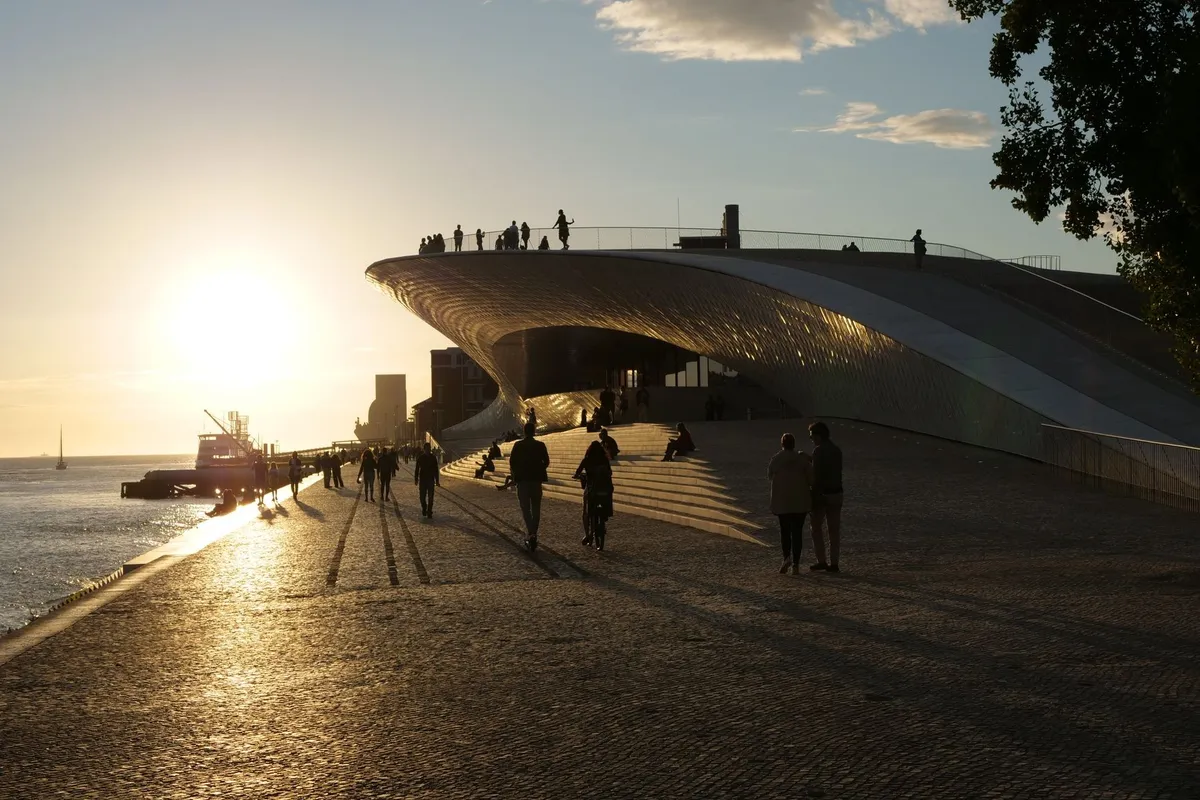
Securing MAAT Lisbon tickets costs €16.00 for non-resident adults and opens access to two distinct institutions standing side by side on the riverbank: a cantilevered contemporary exhibition hall and the colossal red-brick Central Tejo power station. While many visitors arrive solely to walk the undulating roof deck overlooking the Tagus, entering the interior galleries reveals a dual experience bridging early twentieth-century heavy machinery and experimental multidisciplinary art.
Over my seven years living in Lisbon, I have watched the museum campus evolve into one of the cultural anchors of the waterfront. Because the site sits between high-speed suburban train tracks and a wide river highway, reaching the entrance, navigating the ticket options, and budgeting your museum hours requires specific planning before you set out from central Lisbon.
Location, Transit, and Arrival Logistics on the Belém Waterfront
Transit Routes: Trains, Trams, and the Pedestrian Overpass
The museum complex is situated along the Tagus River riverfront promenade at Avenida Brasília (GPS coordinates 38°41'45" N, 09°11'42" W). It stands within the wider Belém cultural district, positioned roughly halfway between the Alcântara docks and the historical monuments farther west. Reaching the site by public transit requires picking the right vehicle based on traffic patterns.
The fastest public transit route from central Lisbon is the suburban train departing from Cais do Sodré station. Trains run along the Belém train station Cascais line operated by CP – Comboios de Portugal, taking roughly seven minutes to reach Belém station. From the station platform, it is an easy 500-meter flat walk eastward along the riverbank path to the ticket counters, taking five to seven minutes.
Alternatively, surface transit lines stop directly across the road corridor at the Altinho MAAT tram stop 15E. Tram 15E and Tram 18E run here alongside Carris bus routes 201, 714, 727, and 751. While the tram picks up passengers at Praça da Figueira and Praça do Comércio, Tram 15E frequently suffers from severe crowding and automotive congestion along Avenida 24 de Julho, often stretching the journey past 35 minutes.
If you arrive from the residential streets of Belém along Calçada do Galvão, do not attempt to cross the highway at street level. Walk up the dedicated pedestrian railway overpass bridge spanning Avenida da Índia and the train tracks, which lands you directly on the museum roof.
Driving, Parking Facilities, and Riverfront Cycling Access
Driving to the venue along Avenida Brasília is straightforward outside peak commuting periods, but on-site vehicle access is restricted. A dedicated free public automobile car park is located 500 meters away from the museum entrance. During sunny weekends, this surface lot fills early with local families strolling the waterfront.
For active travelers, cycling along the waterfront remains one of the most efficient ways to travel from central Lisbon. A separated, completely flat bike lane extends from the Cais do Sodré ferry terminal directly to the museum perimeter. Outdoor bicycle locking racks stand adjacent to the main building entrance.
Lisbon’s municipal bike-sharing network, GIRA, operates dock stations along this route. Station 203 sits on Avenida Brasília right beside the Central Tejo complex, allowing riders to drop off or unlock standard and electric pedal-assist bicycles directly outside the gallery grounds.
Building Accessibility, Luggage Policies, and Site Rules
Exhibition areas enforce a strict baggage policy. Large backpacks, daypacks exceeding small personal bag dimensions, travel suitcases, and non-collapsible umbrellas are barred from all exhibition galleries. Visitors must deposit these items into self-service lockers located inside the cloakrooms, which operate with a refundable €1 coin.
The self-service lockers only fit daypacks, camera bags, and small shoulder totes. Full-sized airline suitcases and large carry-ons will not fit, and the museum provides no oversized luggage holding room. Drop large bags at city center luggage storage lockers before taking transit.
Indoor museum spaces do not allow domestic animals or pets. The only exceptions permitted by security personnel are certified service animals and guide dogs accompanying visitors with disabilities. Strollers are permitted throughout the public circulation routes.
Mobility access across the 38,000-square-meter campus is well engineered. Both the new gallery pavilion and the historical power plant feature step-free ramps, mechanical lifts, and elevator links across all floor levels. The reception desk maintains two complimentary manual wheelchairs available for guest use on a first-come basis.
Museum Architecture and the MAAT Rooftop Lisbon Experience
Amanda Levete’s Ceramic Wave: AL_A Design and Facade Engineering
The contemporary wing of the museum art architecture technology complex was completed in 2016 by British practice Amanda Levete AL_A architects. The low-slung, cantilevered form arches gently over the river embankment, designed to connect the city grid behind the train tracks down to the water’s edge without blocking views of the Tagus.
The exterior envelope of the pavilion features roughly 15,000 three-dimensional glazed ceramic tiles. Crafted as an architectural nod to Portuguese tilemaking traditions, these pale, sculpted ceramic surfaces capture and break up the Atlantic light. The tiles reflect moving river ripples and alter their appearance as the angle of the sun shifts across the sky.
Because the main facade faces south-southwest toward the river, low-angle afternoon sun creates sharp shadow lines across the textured cladding. Photographers looking to document the tilework will find the clearest three-dimensional textures during the late afternoon hours, roughly between 16:00 and 18:30, when solar glare softens against the waterfront.
Free Panoramic Views from the MAAT Rooftop Public Viewpoint
The curved roof of the AL_A pavilion functions as the MAAT rooftop Lisbon public terrace. The structure gently rises directly from the riverfront promenade, allowing anyone to stroll up the slope without entering through a security checkpoint. Access to the entire rooftop deck is completely free of charge and requires no museum admission ticket.
Standing on the MAAT rooftop public viewpoint offers an unbroken panorama of the Tagus estuary. To the east, you look directly at the steel spans of the 25 de Abril suspension bridge. Looking directly across to the southern bank in Almada, the tall concrete pedestal of the Santuário Nacional de Cristo Rei monument stands clear against the skyline.
The rooftop terrace remains open continuously during daylight and evening hours. I often see local runners pause on the limestone incline to stretch, while office workers sit along the elevated ledges during late afternoons to watch passing cargo ships and commuter ferries cross the river mouth.
Central Tejo Industrial Heritage and Vladimir Djurovic Gardens
Directly adjacent to the white ceramic curve stands the Central Tejo thermoelectric power station, an imposing early twentieth-century industrial complex constructed between 1908 and 1951. Built with massive load-bearing red-brick facades over internal iron framing, the power plant once supplied electricity to Lisbon and its surrounding municipalities.
The historic plant and the modern gallery are united by 38,000 square meters of campus grounds. Landscape architect Vladimir Djurovic designed the surrounding open spaces, integrating indigenous drought-tolerant grasses, native shrubs, and paved walkways that buffer the transition from industrial brickwork to organic contemporary curves.
Walking through the gardens reveals outdoor contemporary sculptures positioned along the lawns. The open layout allows visitors to walk between the two main exhibition buildings while enjoying sheltered riverfront seating away from automotive traffic along the main road.
MAAT Lisbon Tickets, Pricing Tiers, and Booking Channels
Standard Admission, Concession Discounts, and Resident Exemptions
Admission pricing follows a transparent tier based on residency and age. A standard general admission ticket for non-resident adults costs €16.00 (approximately $17.50 USD). This single entry pass grants complete access to both the contemporary installations in the AL_A gallery and all industrial exhibition circuits inside Central Tejo.
Concession rates apply to several visitor categories upon presenting valid documentation at the box office. Higher education and secondary students under 30 years old pay €12.00, representing a 25% discount. Seniors aged 65 and over receive a 15% discount, bringing the admission price to €13.60. Children aged 12 and under, companions of visitors with registered disabilities, and accredited journalists enter for free.
Free museum entry on the first Sunday of each month (10:00 to 13:00) is legally restricted to permanent residents of Portugal presenting citizen or residency cards. Non-resident international travelers must purchase standard paid tickets even during Sunday morning hours.
Legal residents of Portugal receive discounted admission rates year-round on regular days. Resident adults pay €12.00, resident students under 30 pay €9.00, and resident seniors pay €10.20 when presenting official Portuguese identification at the counter.
| Ticket Category | Non-Resident Price | Resident Price | Included Access |
|---|---|---|---|
| Standard Adult (18–64) | €16.00 | €12.00 | MAAT Gallery + Central Tejo |
| Student (Under 30 with ID) | €12.00 | €9.00 | MAAT Gallery + Central Tejo |
| Senior (Aged 65+) | €13.60 | €10.20 | MAAT Gallery + Central Tejo |
| Children (Aged 12 & under) | €0.00 | €0.00 | MAAT Gallery + Central Tejo |
| Rooftop Viewpoint | €0.00 | €0.00 | Rooftop Terrace Only |
Combined Passes: CABE Pass, Lisboa Card, and Membership Schemes
If you plan to tour multiple art institutions across Belém, combined cultural passes offer tangible cost savings. The CABE Contemporary Art Belém pass costs €40.00 (approximately $43.80 USD) for non-residents, representing a 20% package discount. This single pass covers four major venues: MAAT, Museu de Arte Contemporânea de Belém (MAC/CCB), MACAM, and Pavilhão Julião Sarmento.
Holders of the municipal tourist transit card receive a specific concession. The Lisboa Card museum discount provides 15% off standard museum admission. However, this concession can only be applied in person at the on-site ticket counter; it cannot be redeemed through third-party digital voucher kiosks.
For regular visitors or art professionals spending extended periods in Portugal, the annual MAAT Friend membership program provides unlimited access. An individual membership costs €30.00 per year and includes priority fast-track entry alongside a 15% discount in the museum design shop. The MAAT Friend + 1 membership tier costs €40.00 per year, extending unlimited entry privileges to the primary cardholder and one accompanying guest.
Online Booking Portals, Gate Desks, and Cancellation Policies
Visitors can purchase tickets in advance online or at physical ticket counters inside either building. Official digital tickets are processed via MAAT's ticketing integration on BOL (Bilheteira Online). Physical ticketing desks operate in the reception lobbies of both the modern gallery and the Central Tejo brick hall.
Review cancellation rules before completing an online transaction. Tickets purchased directly through the official BOL ticketing portal are strictly non-refundable and cannot be modified once payment clears. If your flight is delayed or transit plans change, your ticket value is forfeited.
Conversely, authorized third-party booking platforms such as GetYourGuide offer flexible cancellation terms, allowing a full refund if canceled up to 3 days (72 hours) prior to your scheduled visit date. If your travel dates are fixed, booking direct via BOL works smoothly; if your itinerary might shift, third-party platforms provide a useful safety cushion.
MAAT Belém Opening Hours, Timing, and Central Tejo Exhibitions
Operational Schedules, Holiday Closures, and Time Budgeting
Standard MAAT Belém opening hours run six days a week from Wednesday through Monday, opening at 10:00 and closing at 19:00. The ticket desks and entry scanners close to new visitors at 18:30, thirty minutes before gallery doors shut.
The museum complex is closed all day every Tuesday. Annual scheduled closures also take place on January 1, May 1, and December 25. Additionally, the museum operates on reduced hours on Christmas Eve (December 24) and New Year's Eve (December 31), closing early at 15:00.
Budgeting your schedule accurately avoids rushing through the industrial halls. A self-paced visit through both wings requires between 2 and 2.5 hours. Expect to spend 60 to 75 minutes navigating the machinery circuits inside Central Tejo, 45 to 60 minutes exploring the AL_A gallery rooms, and roughly 20 minutes walking the outdoor gardens and rooftop.
Central Tejo Exhibitions and the Fábrica da Eletricidade Circuit
The core attraction inside the brick power station is the Fábrica da Eletricidade permanent exhibition. The facility operated as a coal-fired thermoelectric plant supplying power to Lisbon, and the interior preserves the authentic heavy industrial equipment exactly as it stood when production ceased.
The self-guided walking route guides you past four massive high-pressure boilers towering through multiple floor heights. You walk along metal catwalks, peer into combustion hearths and ash pits, and trace coal conveyor belts that carried fuel into the furnaces. Informational panels explain the harsh manual labor performed by boiler stokers shoveling tons of coal in extreme heat.
The industrial route culminates in the Low-Pressure Machinery Room and Condenser Hall. Massive steam turbines, electrical alternators, circuit breakers, and water pumping conduits line the tiled floors. This section of the Central Tejo exhibitions offers clear educational value for engineering buffs and older children curious about early industrial technology.
Rotating Contemporary Art Installations in the AL_A Gallery
Inside the Amanda Levete wing, the curatorial focus shifts entirely to modern practice. The building houses temporary exhibitions drawing from the Fundação EDP cultural collection alongside international site-specific commissions. The space lacks traditional partition walls, featuring an expansive subterranean Oval Gallery surrounded by an open curving ramp.
Curators use this uninterrupted volume to mount ambitious contemporary art installations Lisbon rarely sees elsewhere. Past rotations have featured large-scale spatial interventions, kinetic light sculptures, acoustic soundscapes, and multi-channel video projections that interact with the curved concrete perimeter.
The museum maintains an active schedule, staging up to 15 to 18 temporary projects annually across its spaces, including the Project Room and Video Room. Major overhauls of the primary gallery installations take place two to three times per year during seasonal shifts, meaning returning visitors will regularly encounter completely reconfigured interiors.
On-Site Experience: Crowds, Noise Levels, and Honest Drawbacks
Crowd Dynamics, Noise Factors, and Physical Comfort
Interior visitor flow varies significantly across the week. Weekday mornings between 10:00 and 12:00 remain the quietest time to tour both wings, offering clear sightlines and empty boiler walkways. Peak indoor crowding gathers on Saturday and Sunday afternoons between 14:00 and 17:00, when tour groups and regional day-trippers arrive from Jerónimos Monastery.
Acoustic comfort inside the modern building requires consideration. The Oval Gallery consists of bare curved concrete and expansive hard floors with minimal sound-dampening panels. When several school groups or noisy tour parties walk through simultaneously, footstep echoes and ambient speech bounce noticeably off the perimeter walls.
The walking surface of the rooftop viewpoint is paved with pale Portuguese limestone calçada, while the lower perimeter transitions into glazed ceramic tile. During rainy winter conditions, these angled ramps become slick. Wear shoes with textured rubber soles to avoid slipping on the inclines.
The Honest Cons: Conceptual Disconnects and Environmental Exposure
While the architectural profile draws international acclaim, the museum has real operational limitations that leave some travelers frustrated. The primary physical drawback is the total absence of shade across the 7,000-square-meter rooftop terrace. During summer afternoons when temperatures climb past 30 °C, the white stone reflects intense glare and radiant heat. Combined with stiff Atlantic wind gusts off the river, spending more than fifteen minutes on the roof can become physically taxing.
Inside the modern wing, the exhibitions lean heavily into esoteric, avant-garde contemporary concepts. Visitors expecting traditional oil paintings, classical sculpture, or narrative Portuguese art history will not find them here. If conceptual installations, video loops, and abstract spatial essays do not appeal to your tastes, the €16.00 ticket price may feel excessive.
Finally, the complex layout is physically fragmented. Moving between the modern AL_A pavilion and Central Tejo requires walking roughly 150 meters outdoors through the garden paths. Because tickets must be rescanned at the entrance of each building, you must keep your physical paper ticket or smartphone QR code accessible throughout your visit.
Final Verdict: Who Should Visit MAAT and Who Should Skip It?
Visitor Suitability Profiles and Practical Cultural Alternatives
MAAT delivers excellent value for travelers who appreciate innovative modern architecture, industrial history, and experimental art forms. If you enjoy observing raw technological heritage, the preserved boiler rooms inside Central Tejo are among the finest intact industrial museum spaces in Southern Europe. For design photographers, the exterior ceramic skin and free rooftop vista justify making the trip down to the riverbank.
Conversely, travelers on a compressed half-day schedule should consider skipping the interior galleries entirely. You can walk up the rooftop deck for panoramic river photos without spending a cent, leaving your ticket budget for the Manueline cloisters at Jerónimos Monastery located 1.1 kilometers west. If you want classic twentieth-century fine art–such as works by Picasso, Dalí, or modern Portuguese painters–the nearby MAC/CCB within the Belém cultural district offers a more rewarding permanent collection.
| Visitor Interest | Recommended Action | Alternative Lisbon Destination |
|---|---|---|
| Modern Architecture & Sunsets | Visit MAAT Roof (Free) + AL_A Gallery | Belém Tower riverfront promenade |
| Industrial Machinery & STEM | Tour Central Tejo Fábrica da Eletricidade | Museu da Carris (Alcântara) |
| Classical Modern Art (Canvases/Sculpture) | Skip MAAT Interior | MAC/CCB (Coleção Berardo) |
| Portuguese History & Gothic Heritage | Skip MAAT Interior | Jerónimos Monastery / Castelo de São Jorge |
Final Takeaway and Essential Pre-Arrival Checklist
Combining free public roof access with a €16.00 dual-museum ticket makes MAAT a flexible stop on the waterfront. To make your visit run smoothly without administrative hiccups, review this practical checklist before heading to Belém:
- Check the calendar: Confirm you are not visiting on a Tuesday, when both exhibition wings remain closed all day.
- Pick your ticket vendor: Buy directly via BOL if your travel schedule is confirmed; use third-party platforms if you require a 72-hour cancellation buffer.
- Carry physical change: Pack a physical €1 coin to unlock the mandatory storage lockers, as daypacks are strictly barred from the galleries.
- Dress for river weather: Wear non-slip walking shoes for the limestone roof inclines, and carry sun protection during summer or a windbreaker during breezy seasons.
- Save your ticket voucher: Retain your digital bar code or paper stub after entering the first building, as security staff rescan tickets at the second hall.